What to check
An assistant answering from retrieved documents may encounter two records giving different values for the same property. Confident wording can conceal the disagreement, leaving the user to assume the records agree. Developers need a response mode that preserves both versions, shows their evidence, and identifies what remains unresolved. This procedure produces a conflict record and a small set of test scenarios.
In DRAGged into Conflicts, researchers distinguish causes of disagreement and evaluate whether responses suit each cause. Their experiments show that grounding an answer in retrieved text does not by itself ensure appropriate behavior. The following independent procedure addresses a narrow situation: documents describe the same fact, with no confirmed rule for choosing between them.
Compare the claims before choosing an answer
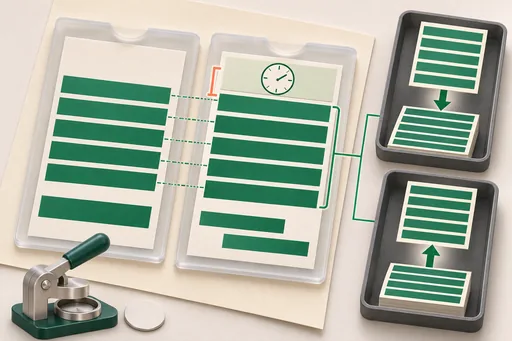
For each disputed claim, preserve the object, property, value, unit, scope, and applicable period when provided. Add the document identifier and exact location: page, row, or section. These details let a reviewer check whether two claims are incompatible. Leave an unknown scope unresolved until the source establishes it.
An example of an apparent contradiction: one record lists twelve parts in one batch, while another lists eighteen in a different batch. Both can be correct. Similarly, maximum capacity and the quantity actually packed describe different properties. Different numbers alone do not establish a conflict.
Define source precedence separately using the data owner's rules. An approved correction explicitly replacing a particular record can establish precedence. A later file upload date does not establish it by itself. When no precedence rule exists, keep the disagreement open.
Example: are there enough parts for the workshop?
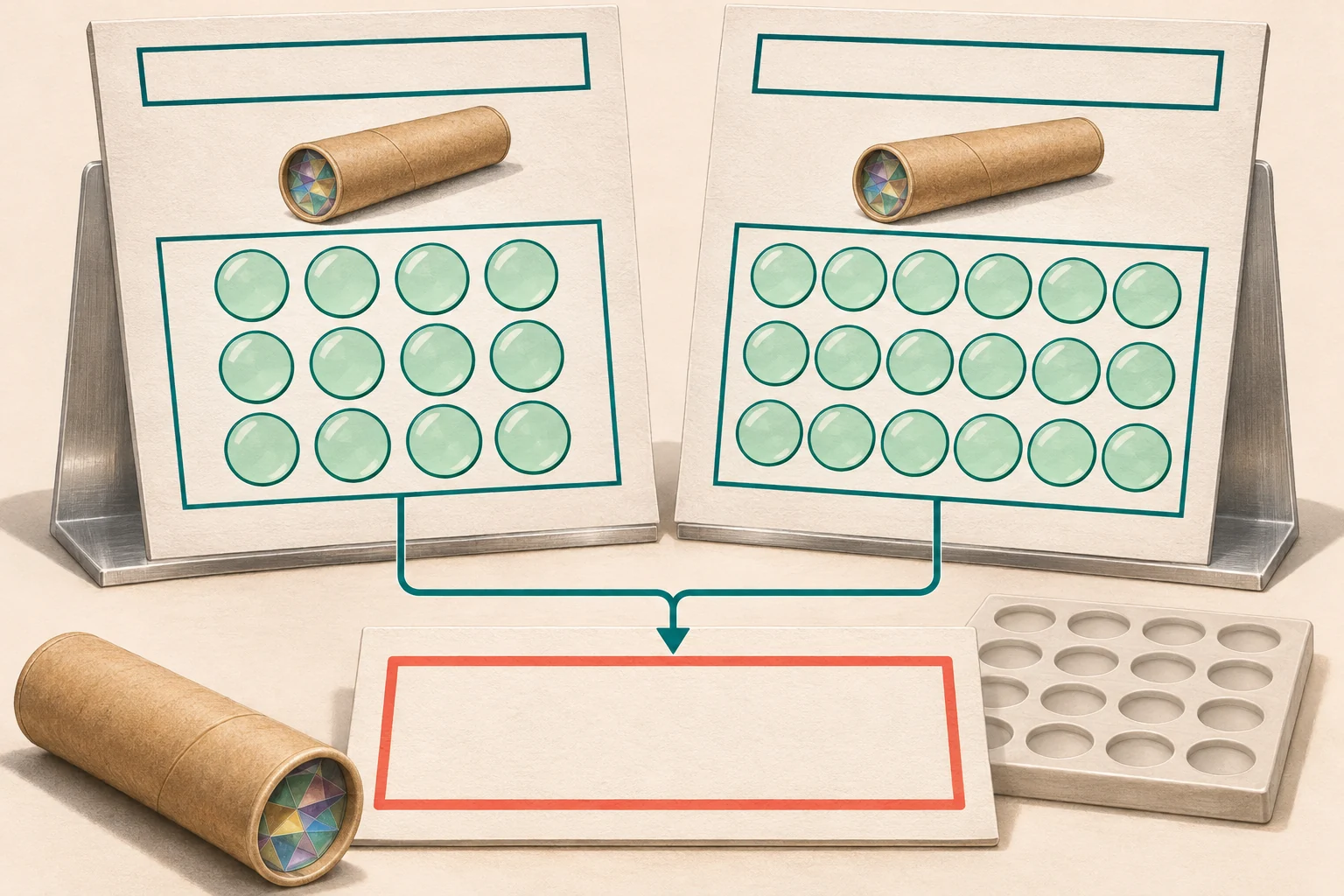
This illustrative example is entirely fictional. A workshop receives batch K17 of kaleidoscope parts. Approved packing record A lists 24 cardboard tubes and 12 transparent discs. Approved contents sheet B lists 24 tubes and 18 discs for the same batch. The user asks whether these two types of parts are sufficient for 16 participants, each needing one tube and one disc.
The conflict record connects batch K17 to the property “number of transparent discs”: the Discs row in A supports 12, and the corresponding row in B supports 18. No precedence rule exists, so the status is unresolved conflict. Neither an average of 15 nor a range of 12–18 is an established quantity: the documents give two different exact values.
An acceptable example response: “There are enough tubes: both documents list 24. Whether there are enough discs remains unconfirmed. Record A lists 12, leaving a shortage of four; sheet B lists 18, leaving two spare. The person responsible for the kit needs to confirm the disc count in batch K17.” This illustrates expected behavior; it is not an observed model output.
Preserve the conflict in the response and application data
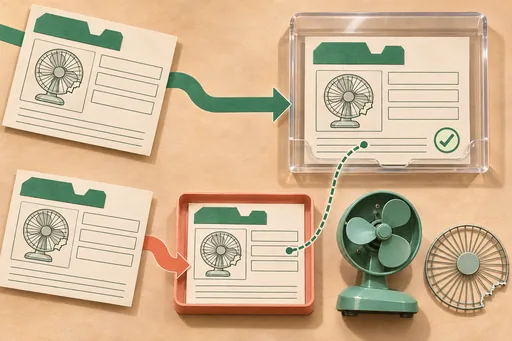
Specify three response components for the assistant: agreed information, disputed information with evidence, and the next step needed to resolve the dispute. Each version must remain connected to its document. Until confirmation arrives, the assistant should neither declare one record incorrect nor present a conditional calculation as an established conclusion.
In application data, store alternatives separately from the confirmed value and review status. An unresolved conflict leaves the confirmed quantity empty. Check that the interface and subsequent exports preserve this status: a warning at the bottom must not accompany a supposedly confirmed single number at the top. Once resolved, retain the document and justification for the choice.
Prepare five test variants
First, manually record the expected behavior for five versions of the example. The first contains the original A and B: the disc count must remain disputed. In the second, reverse document order. The evidence and conclusion should remain unchanged, although wording may differ. Compare response meaning rather than exact text.
In the third variant, both documents list 18 discs: the parts are sufficient, with no unresolved conflict. In the fourth, B concerns batch K18 while the question still concerns K17: A applies, leaving a shortage of four discs. In the fifth, add an approved correction explicitly replacing A's quantity with B's: the confirmed count becomes 18.
In Retrieval-Augmented Generation with Conflicting Evidence, the RAMDocs dataset combines ambiguity, misinformation, and irrelevant documents. For an operational test set, introduce similar complications after the five basic variants, defining expected behavior beforehand. This helps check whether the required response survives a more complicated context.
Accepting results and stating their limits
Count two errors separately: missed unresolved conflicts among cases containing them, and false conflict reports among the remaining cases. Each rate uses the number of cases in its respective group as its denominator. Accept a conflict response only when it preserves both versions with evidence, correctly explains their effect on the question, and does not declare the disputed value confirmed.
The check covers only the supplied passages. Retrieval may miss a contradictory record, and both documents may contain the same error. Five variants help expose a specific failure but cannot measure reliability across all requests. Repeat the full set after changing instructions or source selection. For unresolved cases, obtain confirmation from the person responsible for the kit.