Start with the minimum evidence set
In AI search, an application often retrieves individual document chunks and passes them to a model. A boundary error happens before the answer: permission remains in one chunk, while its condition or exception moves into another. Search may find a passage containing the right words, yet a reader could lack enough information to make the correct decision. It therefore helps to prepare chunks by starting with questions about the document.
The following is a proposed procedure for your own knowledge base. Before configuring search, prepare, for example, 12 questions covering ordinary rules, exceptions, and connections between sections. For each, manually mark the minimum set of sentences needed to answer it. This might be one line, or a rule with a qualification and a term’s definition. This evidence set becomes your reference: neither a matching topic nor a polished answer can replace it.
First identify structural boundaries
Microsoft’s document chunking guidance describes approaches based on size, sentences, and structure; overlap repeats some text between neighboring chunks. For this procedure, start with headings and paragraphs, then manually identify boundaries that break a dependency.
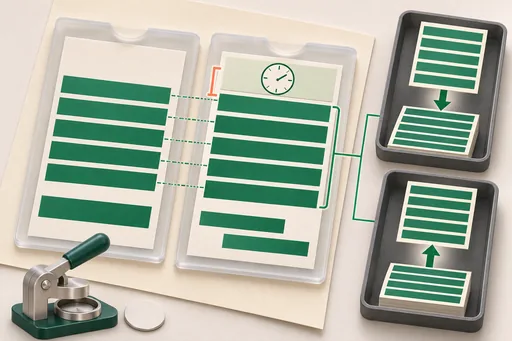
Describe the splitting rule in words: one chunk contains a complete provision and its conditions. Treat the length limit as a reason to review a boundary. If a section is large, divide it by individual actions, repeating the relevant service or item name. Treat “except,” “only,” “in this case,” and references to other provisions as signals to examine neighboring text, rather than automatic cut points.
Check tables and lists separately. A quantity without its column heading loses meaning; a “not allowed” item may depend on an introductory sentence above the list. In this proposed scheme, keep those explanations with the data. If you add a heading to extracted text, identify it as a metadata field, so an editorial addition is not presented as a quotation.
Illustrative example: a rule and its exception
Illustrative example: a fictional board game rental policy states, “A regular game can be extended for three days if there is no subsequent booking.” The next sentence specifies, “Games in the new arrivals category cannot be extended.” If the split falls between them, “Can I extend a new arrival if nobody is waiting?” might retrieve only the general permission. This is a possible preparation defect, not an observed test result.
Keep both sentences in one chunk headed “Rental extensions.” Store the next section, about checking contents, separately: the presence of game pieces does not explain extension conditions. The reference answer for a new arrival is “no.” For a regular game with no subsequent booking, it is “yes, for three days.” The checkable result is specific: both decisions can be justified using one stored chunk, without consulting the next page.
Preserve origins and connections between chunks
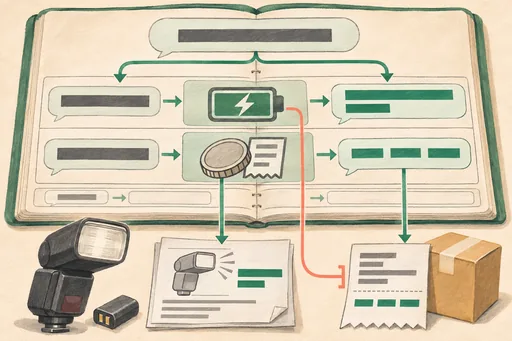
Keep each chunk’s origin verifiable. Microsoft’s index design includes a separate chunk identifier and a field connecting it to the source document; a title can repeat across child records. For your own database, create a record containing the document, version, section, start and end positions, text, and related chunks. The additional fields are this procedure’s recommendation, not a service’s mandatory format.
If a necessary definition is far away, record an explicit connection to it. When adding linked text, check that the document and version match. Overlap between neighboring chunks cannot replace this connection: a distant definition may fall outside it. Mark repeated passages in search results so three almost identical copies of one rule do not appear to be three independent confirmations. Also check whether space remains for the exception.
Compare approaches using the same questions
To evaluate splitting, prepare two versions from the same document collection. Keep the embedding model, search algorithm, questions, a maximum of three retrieved chunks, and the overall context budget fixed. Treat a chunk that cannot fit in full as undelivered. First evaluate retrieved material without generating an answer: does it contain the complete reference evidence set? If any required part is missing, the question fails, even when the general section was found.
Illustrative calculation: for 12 questions, the first version delivered complete evidence sets for eight, and the second for ten. That is 8/12, or 66.7%, versus 10/12, or 83.3%. These fictional numbers explain the calculation. They do not describe SeaGenera or any particular model. Record which exceptions were lost separately: an overall percentage can hide deterioration in an important question group.
After revising boundaries, give another person several chunks without the original document. Ask them to explain their decision and identify sufficient supporting lines. Add new question paraphrases that were not used during configuration. If someone must guess a pronoun’s meaning or search for a missing qualification, return the chunk record for revision. Save the questions and annotations for the next database change.
Check limitations and updates
Larger chunks also need evaluation. In the 2023 study Lost in the Middle, the position of relevant information within a long context affected the evaluated models’ results. This observation does not establish a universal size for today’s systems. The practical implication for this procedure is to check application answers separately after checking evidence completeness, particularly when supplying entire large sections.
Add an update check: change the exception in a test copy and verify that search no longer returns the previous version as current. A deleted section should also stop serving as evidence. If you use embeddings through SeaGenera’s API, perform this check in your application. Receiving a vector does not confirm correct boundaries. Document the outcome as splitting rules, provenance records, and questions with their expected evidence sets.