Define the decision the test must support
A team that has shortlisted several text models needs an answer to a specific question: which can prepare a draft request from a customer message? Define a narrow task to make the result verifiable. The model extracts information, and an employee checks the draft before processing the order.
In this protocol, the draft has four required fields: order number, requested action, whether clarification is needed, and supporting excerpts from the message. Success means getting every field right. Clear writing cannot compensate for an incorrect action or order number.
The comparison produces a record for each candidate, showing errors by message type and conditions for further testing. All dataset sizes and rules below are an original proposal for a small pilot. No models were run for this article, and no measured results are reported.
Separate development from final testing
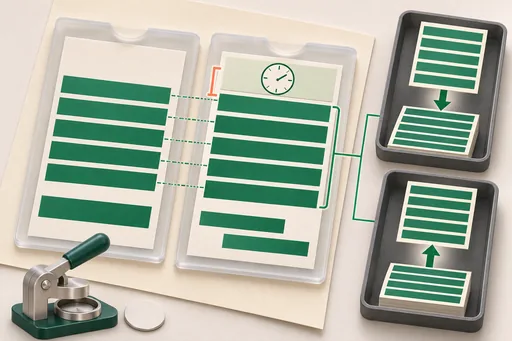
Hugging Face Evaluate documentation distinguishes data used for tuning from data used for final testing. Apply that principle to your instruction: prepare, for example, six development messages and a separate test set. If you change the instruction after inspecting test answers, the next final test needs fresh, previously unused messages.
For an illustrative pilot, use 24 test messages: eight with complete information, eight with missing details, and eight correcting an earlier intention. Assign each message to one main group. This selection deliberately highlights task difficulties; it does not reproduce their frequency in the live workload.
Before collecting answers, manually fill in the reference fields and document acceptable wording variations. Have another person check the references against the messages. If employees disagree about a customer’s intention, clarify the labeling rule first: an ambiguous reference makes the cause of disagreement harder to identify.
Record the conditions of every attempt
Give candidates identical messages, field requirements, and rules for missing information. Start a fresh conversation for each message, without previous answers. This test needs no external tools. Record the model identifier, date, full instruction, and available settings; label unknown values as unknown.
First compare candidates using one shared instruction. If you subsequently adapt it for individual models, use only development messages and retain both versions. The resulting performance describes the combination of model and instruction. That combination must be reproduced in the next evaluation.
Anthropic notes that results can vary between attempts and recommends repeated trials. For this pilot, you could schedule three attempts per message for every candidate in advance. Retain every answer. Track request delivery failures separately from incorrect field extraction, while including them in the comparison record.
Resolve an illustrative message before grading
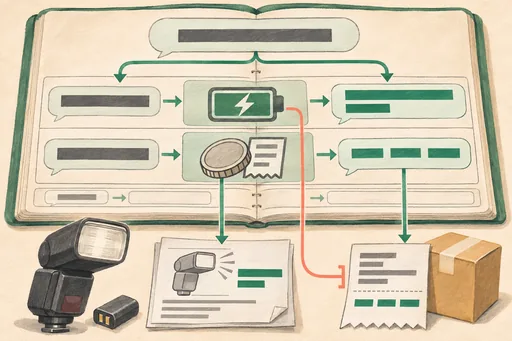
Illustrative message: “We wanted to cancel order 4182, but changed our minds: please change the delivery address. We will provide the new address later.” This checks two distinct abilities: recognizing a revised intention and preserving uncertainty where the customer has not supplied necessary information.
The example’s reference is: order number, 4182; action, change delivery address; clarification needed, yes. The action is supported by “please change the delivery address,” and the clarification requirement by “We will provide the new address later.” The supporting field must allow multiple excerpts.
Possible errors in this illustration include extracting cancellation, missing the clarification requirement, or inventing an address. Each provides a different reason to reject the draft. “Change address” and “change delivery address” can count as equivalent if that rule was documented before results were inspected.
Check fields, consistency, and grading quality
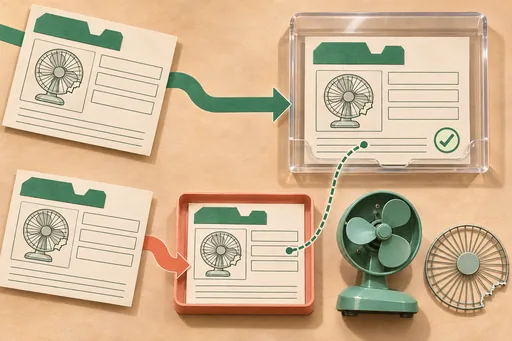
For every answer, retain the candidate, message group, case number, and attempt number. Mark each field as correct, incorrect, or requiring review. Track errors in order numbers, actions, and clarification requirements separately: they change what an employee would do with the request.
For each group, report the number of fully correct answers and the total number of answers. Also count messages where all three attempts were correct. This shows both individual answer quality and consistency on particular cases. One successful attempt should not conceal two failed attempts.
Check the labeling itself: hide model names and ask a colleague to reassess every disputed answer and a random sample of answers marked correct. Resolve disagreements using the original message and field rule. Apply any corrected rule to every candidate.
The MT-Bench study found answer order and verbosity biases in the AI judges it tested. If you introduce AI grading, check it against human labels. Swap answer order in pairwise comparisons and review contradictory judgments. An order number can be checked directly against the reference.
Make a decision with explicit boundaries
Set the eligibility rule before inspecting results. For example, any incorrect action or order number could block a candidate’s next pilot until the cause is addressed. Meeting this condition permits further testing with human review; it does not establish readiness to process orders independently.
For each candidate, state the next step: expand testing of ordinary messages, improve handling of corrections, or repeat testing after changing the instruction. Preserve differences between candidates that fail on different groups. An overall score can conceal the weakness that matters to your workflow.
A small dataset helps reveal failures but cannot establish reliability across all requests. Repeating a message adds no new scenarios. Deliberately selected difficult groups cannot estimate error frequency in live traffic. A new language, model update, or instruction change requires separate evaluation with fresh messages.