When a similar product violates the request
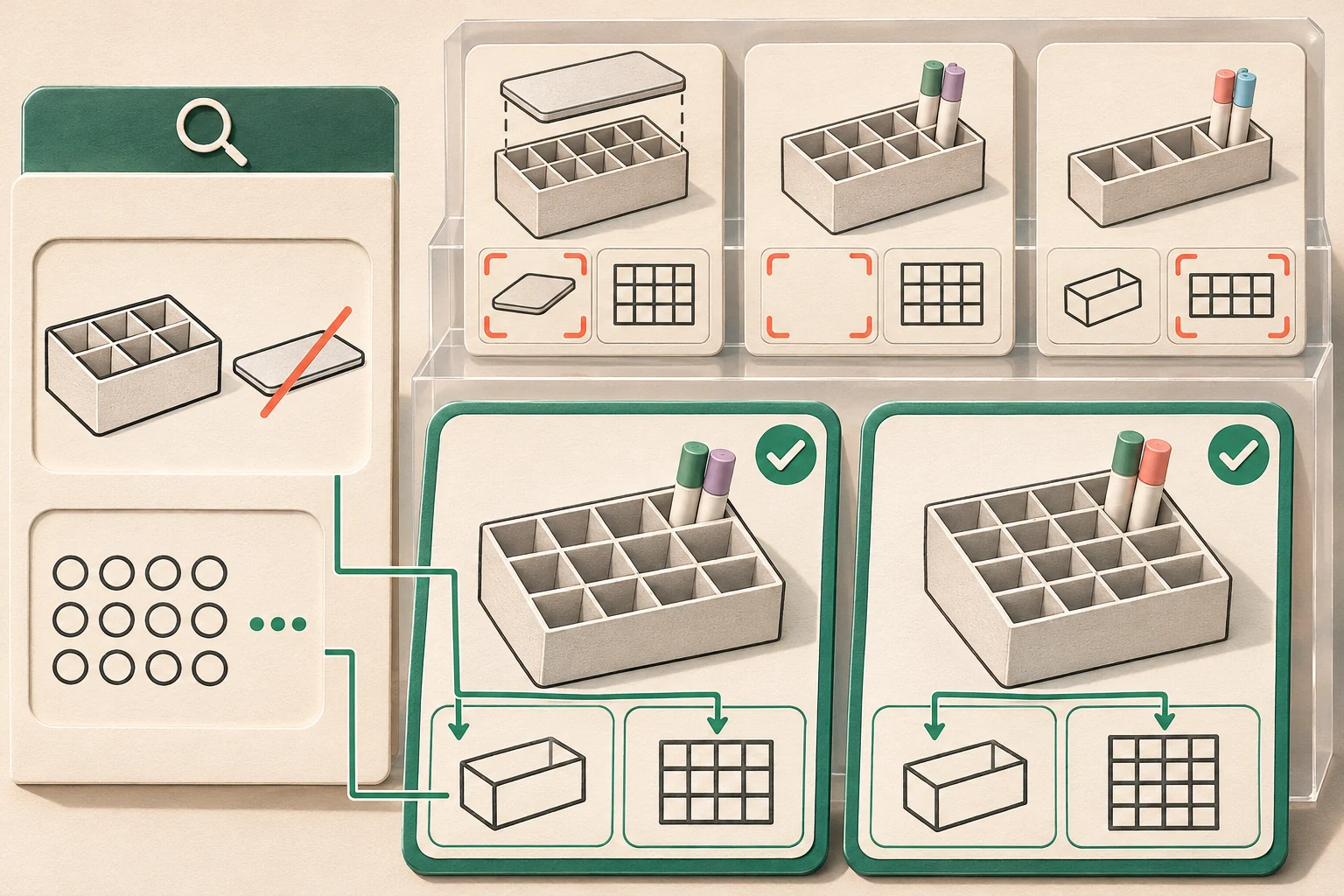
A user wants a marker organizer without a lid, with at least 12 compartments. The catalog returns apparently suitable products, but the first includes a lid and the second has only eight compartments. Developers benefit from separating two checks: whether the product serves the intended purpose and whether it meets every mandatory condition.
Negation has been studied specifically. The 2024 NevIR study tested retrieval systems using documents that differed in negation and found failures to account for it. Those findings concern the systems evaluated in that study; your own search needs a separate assessment using your own data.
The practical output of that assessment is a query record containing eligibility conditions and an expected product set. It helps locate where a requirement disappeared: during query interpretation, preparation of catalog attributes, or result selection. Start with a small collection that a person can review in full.
Turn requirements into fields
In our illustrative example, the product’s purpose is marker storage. That purpose can guide the search for semantically relevant descriptions. Define two mandatory conditions separately: confirmed absence of a lid and at least 12 compartments. Record in advance which catalog field will verify each condition.
Define what those fields mean. The compartment count describes separate spaces, rather than the number of markers that could fit loosely inside. Lid presence concerns the supplied product: a lid shown open in a photograph still exists. Preserve an unknown state for unspecified contents so that the application does not turn missing information into confirmation.
Google’s vector search documentation describes an important behavior: a filter containing only a denied token admits records without that token. The practical implication for our example is that simply excluding a lid token is insufficient. Our proposed eligibility rule requires confirmed lid absence; an unknown attribute remains a reason for further checking.
Build a small reference catalog
The following five records form a fictional teaching example. Organizer A has 12 compartments and no lid. B has 20 compartments and includes a lid. C has 24 compartments, but its supplied contents are unspecified. D has eight compartments and no lid. E has 16 compartments and no lid. All five are intended for markers.
A and E qualify for the original request. B violates the lid condition, while D falls below the compartment threshold. C lacks sufficient information to qualify. This is the expected outcome of the example, not a report of a model run or a measured accuracy result for any service.
Keep supporting evidence beside each record: a short passage from its fictional description confirming the compartment count and supplied contents. C’s evidence field for the lid remains empty. A reviewer should be able to reconstruct the decision from this information. A high search position alone confirms neither compartment count nor lid absence.
Check when filtering happens
Azure AI Search applies restrictions through ordinary string and numeric fields. Its documentation distinguishes filtering during search from filtering after candidate selection and warns that subsequent filtering can miss qualifying results. The point at which conditions are checked therefore matters when designing the search.
Suppose our example’s initial list of three candidates contains B, C, and D. Subsequent eligibility checks remove all three. The empty result says nothing about the other records: qualifying products A and E never entered the initial list. Reordering those three candidates cannot fix the problem.
If the search system supports restrictions during candidate retrieval, assess that mode. When filtering afterward, provide for retrieving additional candidates and define a stopping limit. If that limit is reached, report that no suitable options were found among the checked results. Keep mandatory conditions intact when filling result cards, and avoid declaring the entire catalog empty without sufficient checking.
Check the results manually
Paper cards or a simple spreadsheet are enough for an initial check. Record the original wording, interpreted conditions, candidates before filtering, exclusion reasons, and final list. Try several invented candidate orders. Include one where every qualifying product falls beyond the initial selection boundary.
Then change the requirements. Replacing “at least 12” with “more than 12” should exclude A and leave E. Removing the lid condition makes B and C eligible again while retaining the minimum of 12 compartments. A request for no lid and at least 24 compartments should produce an empty eligible set.
Check condition violations and omissions separately. For this small catalog, compare the output against all five records. If the interface holds three cards, the original request should display both eligible records without adding an unsuitable third. Preserve these expected results for regression checks after changes to query interpretation or selection logic.
Record the solution’s limits
The manual exercise checks eligibility logic and expected outcomes. Actual retrieval behavior, model extraction of conditions, and catalog data quality need separate assessments. Even a correctly applied filter produces the wrong decision when the supplied-contents field is inaccurate. After a product changes, check that its attributes and supporting description remain current.
Agree separately on preferences. “Preferably without a lid” permits a different process from the mandatory “only without a lid.” Preserve the original wording and its accepted interpretation in the query record. If the meaning cannot be established confidently, request clarification rather than silently converting a preference into a mandatory exclusion.
SeaGenera provides embeddings through its API. In the architecture described here, the application developer handles the search index, catalog fields, and condition enforcement. For a handoff, prepare a field dictionary, rules for unknown values, the five illustrative records, and expected result sets. This package supports discussion of specific search failures independently of how attractive the retrieved products appear.