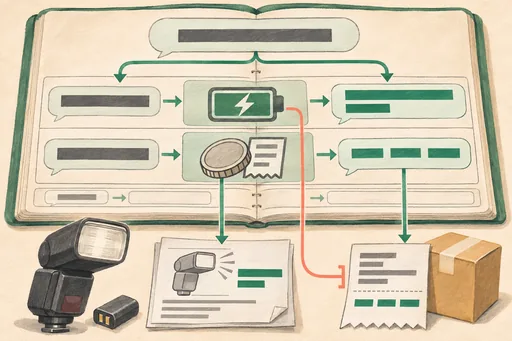
Define the boundary of automation
An AI classifier needs an explicit way to leave a request without a service category. Otherwise, a request for an unsupported service can receive a plausible label and enter the wrong queue. Define the automation boundary before evaluating answers. The practical result is a scope specification, fallback route, and evaluation table.
A 2019 study by Larson and colleagues evaluates requests outside the supported intents separately. Use that distinction to describe your application. For each category, record the requested action, accepted objects, and exclusions; a general service name is insufficient.
Define the unit of classification as one independent request. Provide an operator fallback with two reasons: outside scope and undetermined. The second reason covers messages whose meaning cannot be established from the available context. Preserve both reasons when forwarding requests.
Examine the requested action
Consider this fictional example: a workshop accepts binoculars for lens cleaning and diagnosis of double vision. It does not sell or rent them. “Please book my binoculars in for cleaning” belongs to cleaning; “The image doubled after a fall; I need diagnostics” belongs to diagnostics.
“Can I buy the same binoculars from you?” is outside scope, despite naming the right object. “How much does it cost?” is undetermined without preceding context. Labeling both as unsupported would mix two problems: an unsupported service and insufficient context.
An example instruction is: identify the requested action, choose a category only when its definition fits, otherwise state the reason for operator review. Keep a short supporting phrase from the message with each reference label. For the purchase question, the evidence is “Can I buy,” not simply “binoculars.”
Build a boundary evaluation
Prepare a labeled sample containing supported requests, nearby unsupported services, unrelated topics, and ambiguous messages. Examine nearby cases carefully: binocular rentals share vocabulary with repairs. Have a reviewer check each reference label and its justification against the scope specification. Count ambiguous cases separately from out-of-scope requests.
Separate examples used to refine the instruction from the final evaluation set. Group paraphrases of the same underlying request before splitting the groups. Otherwise, almost identical messages can appear on both sides and make the final check less informative.
Use a sample of ordinary requests to estimate operating results. Maintain a separate diagnostic collection with extra boundary cases. Its deliberately chosen proportions cannot establish how often unsupported requests occur in practice. Review model-generated examples individually before adding them to the reference set.
Freeze the abstention rule
Microsoft's CLU documentation describes a None intent and a threshold below which the highest-scoring intent is replaced by None. It recommends choosing the threshold from project observations; the standard test-set evaluation does not apply it. Therefore, separately check the final decision with the active abstention rule.
For a language model, do not interpret its written “confidence 0.9” as evidence that 90% of similar decisions are correct. That interpretation requires separate calibration checks on independent data. Compare candidate abstention rules on the development sample, then freeze the selected rule before final evaluation.
In SeaGenera's classification API, a choice question lets you specify alternatives through criteria. Include explicit operator fallback alternatives and define their meanings. These endpoints are available through the API; Playground has no classification tab. The client application implements the subsequent routing.
Count errors alongside automation coverage
Evaluate automation coverage alongside the error rate among automatic assignments. This follows the risk–coverage framing in Geifman and El-Yaniv's selective classification work. Increasing refusals alone does not establish that the remaining assignments are reliable.
An illustrative calculation, not a model test: a sample contains 70 supported and 30 unsupported requests. The application assigns service categories to 60 supported requests and five unsupported ones. Three of those 60 supported requests receive the wrong service category. All remaining messages go to an operator.
False admission of unsupported requests is 5 out of 30, or 16.7%. Unnecessary refusal of supported requests is 10 out of 70, or 14.3%. Automation coverage is 65%. Error among automatic assignments is 8 out of 65, or 12.3%, including both kinds of incorrect assignment.
Always show counts beside percentages. If everything goes to an operator, coverage is zero and error among automatic assignments is undefined. Agree acceptable limits for false admissions, unnecessary refusals, and operator workload before selecting a rule.
Check routing and account for limitations
Check the application using prepared responses: abstention, an unknown category, and an empty answer. Verify that abstentions and invalid results reach an operator without the application substituting the first category. Separately compare accepted assignments with labeled messages for semantic correctness. The operator should receive the original request and referral reason.
Start with operator-reviewed decisions. When a new service becomes supported, update the scope and reference labels, then repeat the boundary checks. Record the model, instruction, and category-list versions so that a later regression can be traced to a specific change.
A finite example set cannot cover every future unsupported request. Results apply to the evaluated languages, context, and traffic mix; new requests can change the metrics. This method provides an acceptance record and fallback route, without guaranteeing correct abstention for every unfamiliar message.