Define what you need to verify
Before introducing automatic masking, define the promise your application makes. For example: the model provider receives no contact details from a repair request, while the model retains the fault description. The practical outcome is a set of annotated examples and a decision about which requests qualify for automatic submission. Evaluate model answer quality separately.
Draw the data path: form, your application, intermediary, provider. Mark where replacement happens and where you inspect it. If contact details must stay inside your system, transform them before they leave. An intermediary’s built-in filter means the intermediary initially receives the original text.
NIST SP 800-188 notes that a masking tool may lack sufficient capabilities for full de-identification. Define a limited, testable objective: conceal selected information at a particular transmission boundary. The remaining risk of identifying a person requires separate assessment.
Prepare annotations before testing
For an initial check, we propose 24 entirely fictional records, including requests involving several people. This illustrative size helps organize the work; adequate coverage depends on the application. Use the structure of a real form, but invent its contents. Changing only the name in a real request leaves other information about the person.
Divide the records into three groups of eight: ordinary entries with field labels; unusual spacing, line breaks, abbreviations, and mixed languages; and numbers or equipment identifiers that are safe for this task. Microsoft explains that context affects recognition and that both missed detections and false positives can occur.
Manually mark every passage that must be concealed, including repetitions. Separately mark information that must survive: duration, quantity, and conditions for taking action. Have a second person check these annotations before testing the filter. Resolve ambiguous passages by agreeing on their handling rule first.
Example: a repeated contact in a repair request
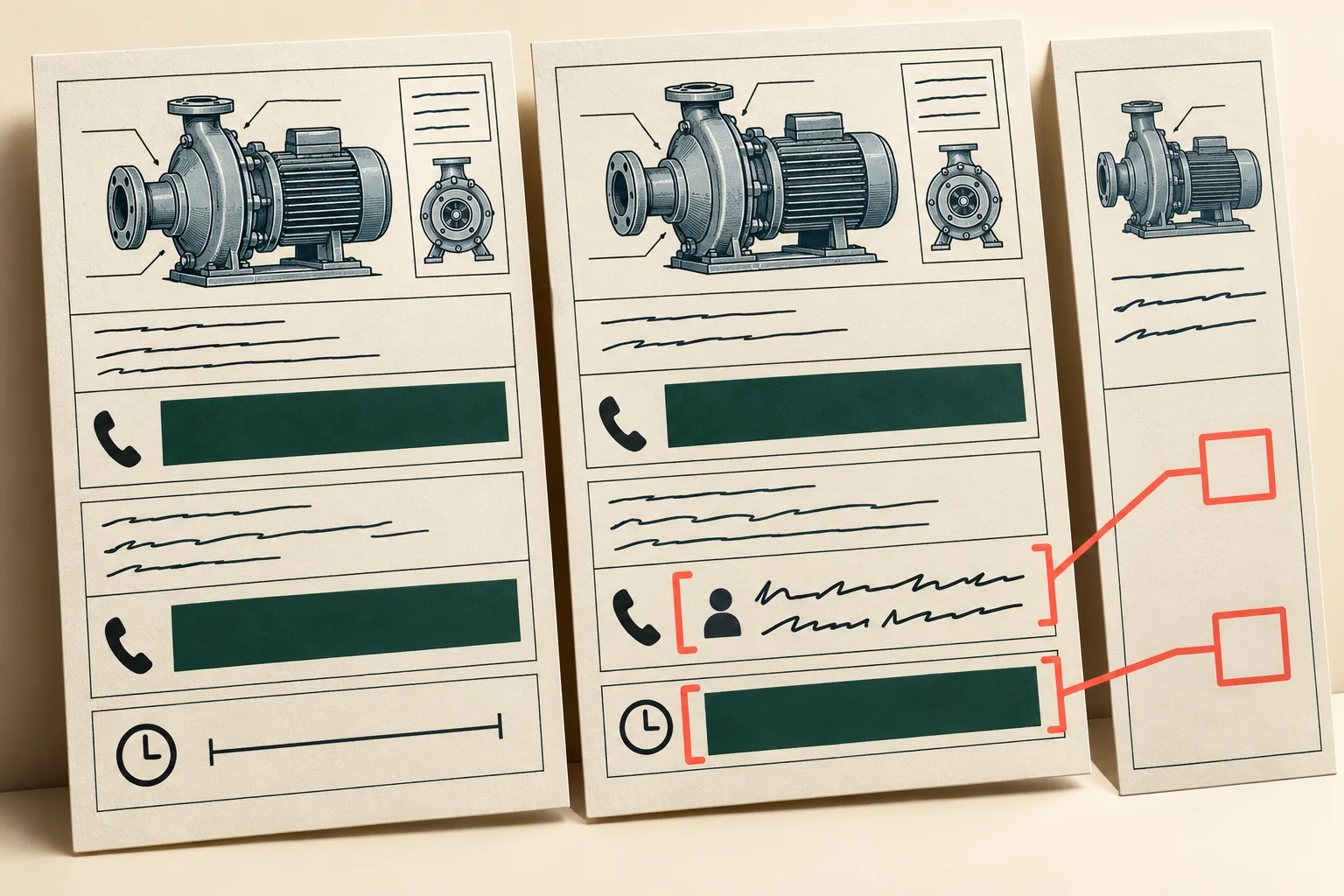
Illustrative request: “Full name: Irina Volkova. Email: irina@example.com. Send the follow-up approval request to irina@example.com. Pump N-40 stopped after 15 minutes. Inspect after cooling.” For a short technical summary, we define three protected occurrences: the name and two appearances of the email address.
The expected transformation replaces the name with a participant placeholder and both addresses with the same contact placeholder. N-40, 15 minutes, and the cooling condition remain. Repeating the contact tests whether every occurrence is processed; matching placeholders additionally test whether the relationship between mentions survives.
If the filter conceals the first address but leaves the second, the record fails. If the cooling condition disappears along with the address, protection has damaged the task. Compare the processed text against the annotations before contacting the model: a successful technical summary alone does not reveal these errors.
Count omissions and unnecessary replacements separately
Presidio Evaluator supports comparing annotated and detected passages with attention to their boundaries. For this check, we propose a strict rule: a protected occurrence counts as successful only when fully concealed. Record a partly exposed name as a miss, and track unnecessary removal of useful text separately.
Recall measures the share of required occurrences concealed; precision measures the share of replacements actually needed. Consider hypothetical numbers without partial matches: 18 of 20 required occurrences are correctly concealed, with three additional unnecessary replacements. Recall is 18 out of 20, or 90%; precision is 18 out of 21, approximately 85.7%. This explains the calculation and does not report SeaGenera test results.
Calculate these measures separately for names, email addresses, and other selected categories. Also report how many records contain at least one omission and how many lose meaning. Numerous successfully concealed addresses must not obscure a single exposed name.
What you can observe when using SeaGenera
According to SeaGenera documentation as of October 22, 2026, masking can be enabled for a text request or at the API key level. The X-SeaGenera-PII-Redaction header confirms the mode; X-SeaGenera-PII-Count reports unique recognized values. This counter cannot be equated with concealed occurrences or treated as a safety score.
Unchanged placeholders are restored in the response. Consequently, the finished response does not show what text the provider received. To test your application’s own filter, send fictional records to a test receiver instead of an external destination and inspect the received request body. This requires no generation. It tests your filter rather than SeaGenera’s internal processing.
SeaGenera’s documented masking applies to ordinary text chat; it does not process images, audio, video, or PDFs. The documentation requires masking to be disabled for attachments, tools, and structured JSON output modes; a key with mandatory protection rejects such a request. These routes need a separate data preparation decision and separate testing.
Record acceptance conditions and limitations
Write down the acceptance condition beforehand. For these 24 records, for example: no required information missed, all important conditions preserved, and relationships between participants and contacts maintained. This is our proposed rule for this test. Passing it still does not prove that future requests will contain no omissions.
In the acceptance record, retain the filter version, data categories, supported formats, results, and excluded routes. By default, operational diagnostics should contain the case identifier and error type rather than the original text. After changing the filter or text preparation process, repeat the full set and add newly discovered cases.
Perform a separate meaning-based review: could the remaining description identify someone? For example, a rare job title, a small locality, and an exact event date may suggest an identity without a name. For excluded or uncertain cases, provide manual preparation before submission or stop the request. Keep the scope of automatic processing explicitly limited.