Define the category boundaries first
If AI sorts incoming messages into categories, it helps to check which text changes affect its decisions. A pair of almost identical messages can reveal that the classifier ignores negation or reacts to a greeting. The practical result is a small diagnostic collection with expected labels and explanations.
Illustrative example: a service sorts delivery messages into “help required,” “no help required,” and “insufficient information.” The first label means an explicitly described current problem; the second means an explicitly described absence of a current problem. Use the third when the message does not support either choice. The classifier receives only one message’s text.
Write rules for borderline cases: a past failure that has been resolved is not a current problem; gratitude alone does not determine the category. These are conditions of the illustrative example, rather than universal support rules. Without this agreement, labeling mistakes can easily be mistaken for AI failures.
Separate two kinds of changes
The CheckList paper describes tests where predictions should remain unchanged after transformations that preserve the correct label, and tests of expected prediction changes. For this task, use two rules: “the label stays the same” and “the label changes to the specified category.” Record the expectation before obtaining the model’s answer.
Illustrative unchanged pair: “The parcel has not arrived” and “Hello! The parcel has not arrived.” Both require help. Illustrative changed pair: “The parcel has not arrived” and “The parcel has arrived.” These require different labels. Change one meaningful feature so you can identify the cause of a possible failure.
The Contrast Sets authors propose small, meaningful changes to original examples that usually change the reference label. This approach examines a specific decision boundary. Success on these examples does not establish that the system understands every message or is reliable overall.
Build 12 pairs covering different checks
For a first pass, we suggest 12 pairs, or 24 input texts. This is a convenient amount for manual review, rather than a statistically justified sample size. Allocate six pairs to preserving the category and six to changing it. Choose natural phrases resembling messages from your audience.
In the first group, make two pairs each for adding greetings, paraphrasing, and reordering independent sentences. In the second, make two each for negation, changes in current status, and adding missing information. This is a proposed structure for the illustrative collection; choose other transformations where your task requires them.
Illustrative status change: “The parcel did not arrive yesterday, and it has not arrived today either” requires help; “The parcel did not arrive yesterday; I received it today” requires no help. Added information example: “Delivery” provides insufficient information; “Delivery is delayed” requires help. Note exactly which distinction each pair tests.
Review the reference labels before running
Ask a second person to label all messages individually in shuffled order, without AI answers or pair identifiers. Give them only the category rules. Then compare labels and explanations. This review helps identify phrases where the collection’s author unknowingly relied on additional context.
Treat disagreement first as a problem with the task definition or example. Clarify the rule and label disputed messages again. If no unambiguous decision is possible, set the pair aside. Human disagreement does not imply “insufficient information”: that category describes message content, rather than the quality of reviewer instructions.
Datasheets for Datasets proposes documenting data’s purpose, composition, collection, and recommended uses. For this collection, keep a short record of its purpose, rule version, phrase origins, and known gaps. For each pair, retain an identifier, both texts, both reference labels, the change type, and a brief justification.
Count fully correct pairs
Submit each message separately using the same classification task. Do not show its paired text, expected labels, or reviewer explanations. Record the model name, date, and available settings. Retain original outputs, including empty responses and unexpected categories: do not silently exclude them from scoring.
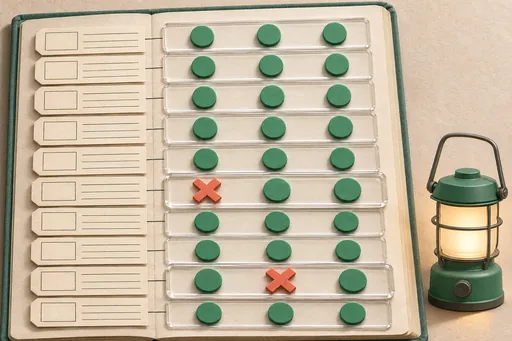
A pair passes only when both labels match the references. Imaginary illustrative result: 18 of 24 answers are correct, giving 75%. However, if the six errors occur in six different pairs, only 6 of 12 pairs pass completely, giving 50%. This demonstrates the calculation; it is not an actual test result.
Report category preservation and category change results separately, then examine each transformation. Identical incorrect labels for two messages do not demonstrate successful robustness. Count unexpected formats or missing responses as errors under a rule recorded in advance. Retain the specific mismatch for every failed pair.
Use failures to guide the next check
Investigate failures in order: is the reference correct, was only the intended feature changed, and was the category boundary respected? Only then change the classifier’s instructions. For example, failure on a resolved delay may indicate that the distinction between past and current problems needs clearer wording.
After a correction, rerun existing pairs and add new phrasings of the same type. Familiar examples help detect returning errors. Independent evaluation requires held-out examples that were not used during adjustment. Do not split variants of one original phrase between adjustment and independent evaluation.
The collection has limitations: artificial pairs do not reveal error frequency in actual traffic, and variants of one template are related. Twelve pairs also cannot cover long conversations, other languages, or every disputed case. Use them to find specific weaknesses; additionally assess performance on actual traffic using a separate sample of real messages.