Define the question your test answers
A small test is useful for finding weaknesses before using text AI. However, “90% quality” hides essential details: which tasks were checked, how many answers were collected, and how a successful answer was selected. A test result describes a particular procedure. Changing that procedure changes what the number means. Start by writing down precisely what you want to learn.
Consider a fictional example: a camping lantern rental desk prepares replies about collecting orders. We care about the first answer’s correctness, before manual edits. Acceptance requires the correct collection time, preservation of the confirmation requirement, and no invented delivery service. Prepare ten different order records with reference facts. This diagnostic collection helps reveal errors; its composition does not reproduce the full stream of requests.
Preserve task counts and attempt order
Create one row per record: task identifier, source facts, instruction version, model and settings, followed by separate answer and verdict fields. For this illustrative plan, specify three separate runs with identical inputs, each in a new conversation. Do not include previous answers or reviewer comments. Preserve the original attempt order: the best answer cannot retrospectively become the first.
Ten tasks and thirty answers remain different quantities. Repeating a task reveals response variability; adding a task broadens the material examined. Anthropic’s statistical recommendations explain that related questions provide less information than the same number of independently selected questions. Keep each answer linked to its task, and do not present thirty attempts as thirty different situations tested.
Example: three results from one collection
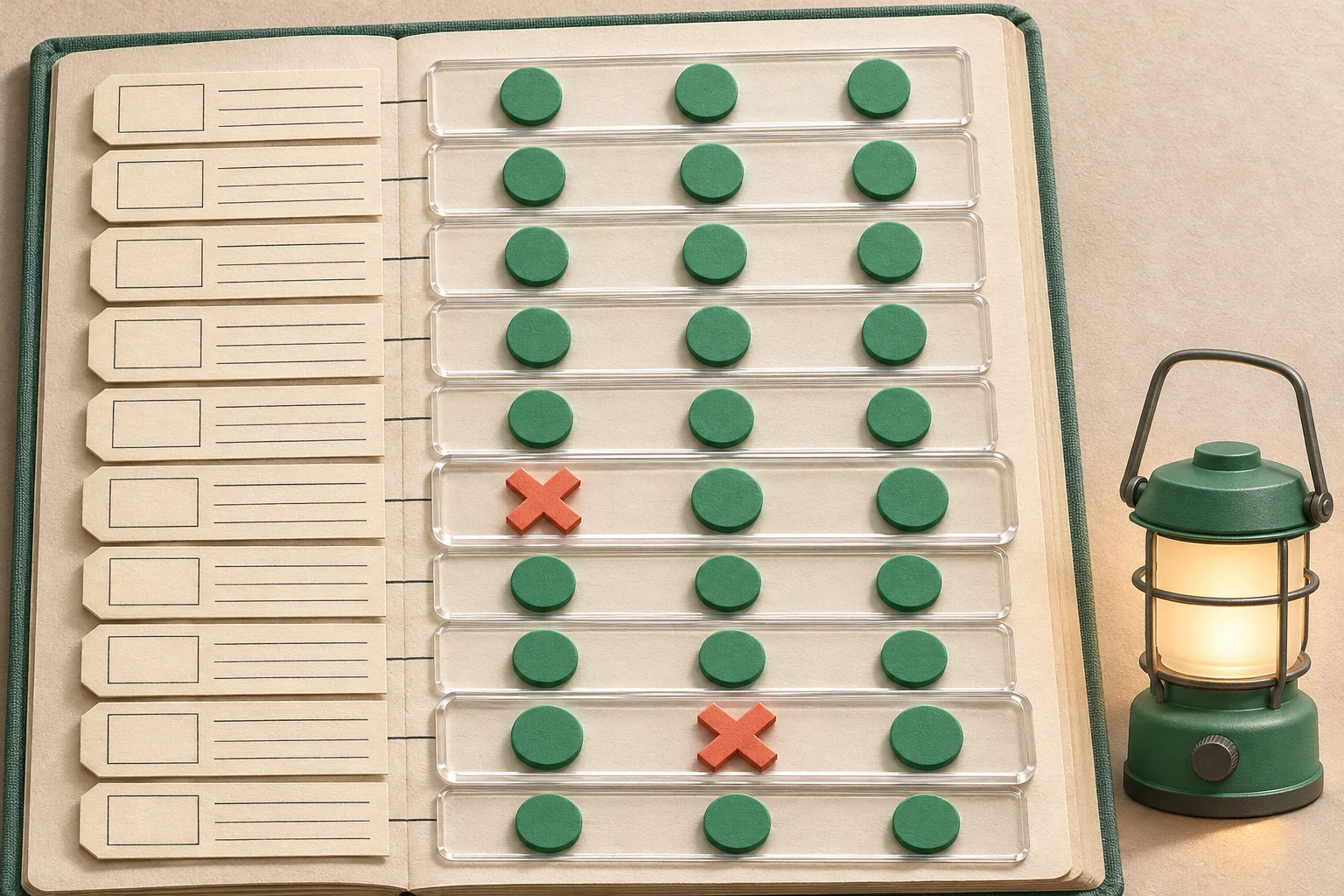
Assume the following illustrative results. All three answers pass in eight rows. For task six, the first answer fails and the next two pass. For task nine, the first and third pass while the second fails. There are 28 accepted answers out of 30. These are hypothetical numbers explaining the method, not test results for any model or SeaGenera.
Now calculate three results: the first answer passes on 9 of 10 tasks; at least one of three passes on 10 of 10; all three pass on 8 of 10. Anthropic distinguishes success on at least one attempt from success on every attempt. When answers are used without selection, use the first-attempt result. An editor choosing between variants also benefits from knowing whether a suitable answer exists.
Why even ten out of ten leaves uncertainty
Consider a separate calculation example: ten new tasks are independently sampled at random from one unchanged stream, with the model, instructions, and settings fixed. Even if every first answer passes, perfect reliability is not established. For 10 successes out of 10, the exact two-sided 95% binomial confidence interval is approximately 69–100%. NIST describes this method for small samples; these bounds are calculated for the illustrative example.
Across repetitions of this procedure, at least 95% of such intervals cover the true success probability. This does not promise that 95% of future answers will be correct. A manually assembled collection shows behavior on selected situations. In the example report, write: “The first answer passed on nine of ten diagnostic tasks; the success rate in real requests was not estimated.” Do not transfer the numerical interval from the separate random-sampling example to this collection.
Verify the calculations before drawing conclusions
You can verify the report without generating new answers. Hide the summary figures and recalculate them from the row-level verdicts. In our example, find exactly one failure in the first column and two rows containing at least one failure. Then open those answers and check each verdict against its order record. The number of rows must match the number of source tasks.
Also test the counting procedure on a copy of the log. For example, replace the previously accepted first answer for task eight with an obviously incorrect collection time. After reassessment, first-answer passes should fall from 9 to 8 out of 10, all-three passes from 8 to 7, while at-least-one passes remain 10 out of 10. A different result indicates an accounting error.
Record the decision and its limits
The final record should include the task, collection provenance, instruction version, settings, task and attempt counts, answer-selection rule, and all three calculated results. Attach descriptions of the two observed errors. In our example, a reasonable next step is to address their causes and continue operator review of drafts. This collection provides no basis for sending answers directly to customers, even though a suitable variant always exists among three attempts.
Set the size of the next evaluation before seeing new results. To estimate performance on everyday requests, collect new, independently sampled requests from that stream; to investigate an unstable task, repeat that task. These provide different information. More paraphrases of one order cannot replace new orders. After changing the instructions, record a separate result and preserve the earlier one so that observations remain linked to the version that produced them.