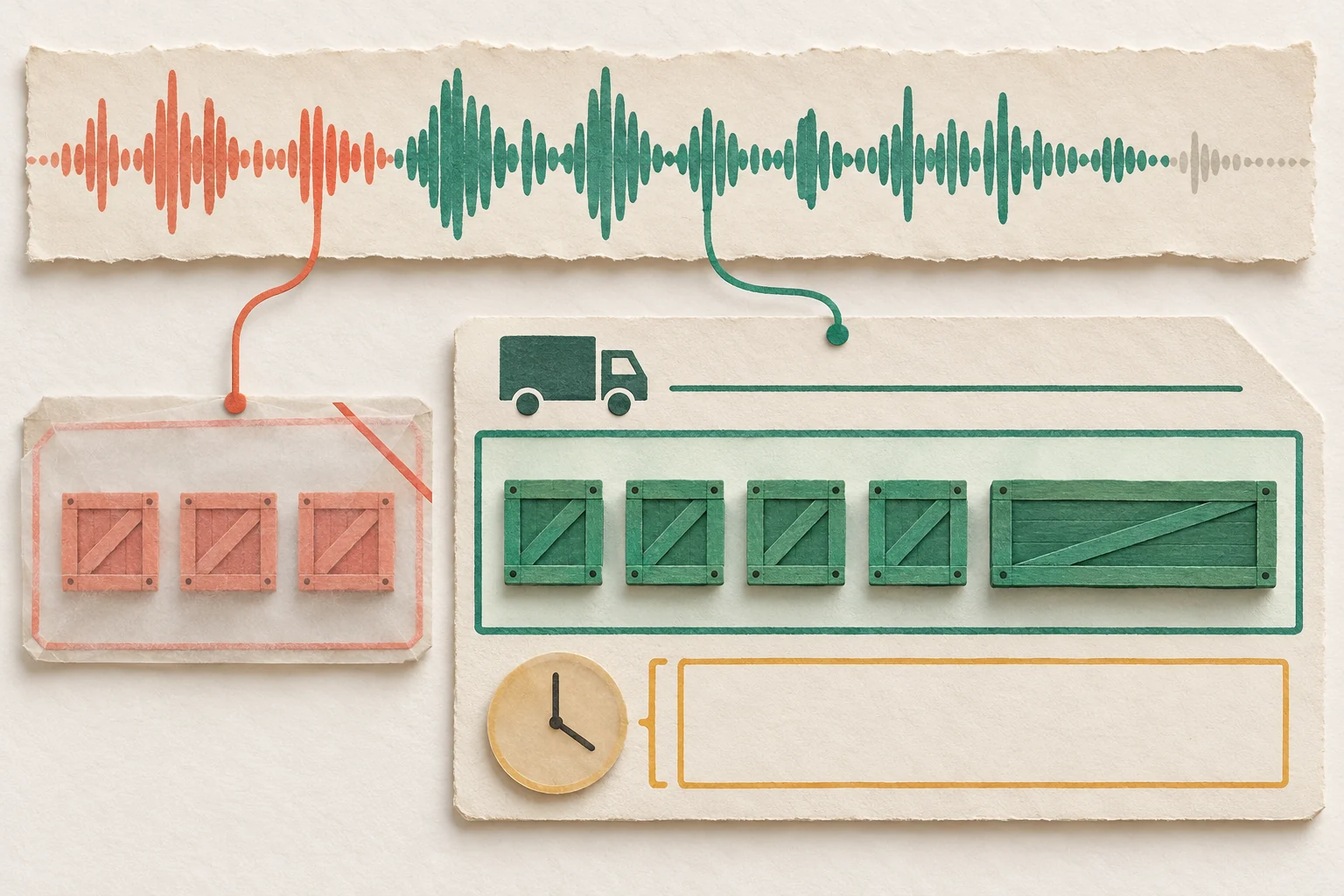
Why preserve the correction history
In a voice request, someone may state a quantity, correct it, and then return to the collection time. AI needs to transfer the current information into a record while preserving the reason for each replacement. Otherwise, a tidy record can conceal which number was withdrawn and which was merely proposed.
The displayed transcript may differ from the sequence of spoken words. Microsoft’s official documentation describes converting spoken numbers into digits and removing repetitions and fillers. This makes it useful to check readable text against the original recording before extracting final values.
The practical result is a record containing the field, current value, earlier version, reason for the change, and review status. Three statuses are useful: verified against the recording, provisional, and clarification required. This is a proposed editorial procedure that can be applied manually with assistance from a text model.
Prepare the material without losing evidence
Keep the original recording available to you, the returned transcript, and a separate working copy. Mark corrections in the working copy while preserving the initial text. Use timestamps to navigate when available. Otherwise, mark intervals manually and check that they cover the complete utterance.
Research by Chen and colleagues on detecting speech disfluencies shows why subsequent words are sometimes needed for a decision. The practical implication for review is to listen through the correction and the continuation explaining its meaning. A short extract may retain the new number while losing what it changes.
Before asking AI, define the required fields: for example, date, total quantity, recipient, and collection time. Allow fields to remain empty. Require a supporting utterance and recording location for every value. Keep any unspoken name, year, or part of the day unknown.
Identify exactly what was replaced
Spilker and colleagues describe self-correction through the original segment, interruption point, correction cue, and replacement. For a working record, mark the earlier version, transition words, and new version. Then separately identify the field affected by the replacement and preserve the surrounding information.
Consider three illustrative examples. “Three, no, five crates” replaces the quantity. “Three crates and another two” adds a quantity. “Three or five, I’ll confirm” leaves the choice open. Identical numbers require different records: a final value, a calculated total, or no confirmed quantity.
Check the scope by asking which object is being discussed, which property is changing, and whether the previously stated date remains valid. The last number may indicate a floor or time. The last surname may refer to someone else. Word order alone cannot determine every field’s current value.
Illustrative example: transporting exhibition models
A fictional voice request says: “Prepare three crates for the fifth of November, no, five. The recipient is Serov, correction, Sergeyev. One crate is long; the others are standard. Collect at ten, although I still need to confirm the time.” This example explains the procedure; it reports no particular model’s results.
After review, the record contains 5 November without an invented year, a total quantity of five, and the surname Sergeyev. The earlier versions, “three” and “Serov,” remain in their respective field histories. Record “ten” as a proposed time with provisional status. The confirmed collection time remains empty.
“One long crate” describes the load’s composition and remains separate from the total quantity. Four standard crates is calculated from five and one, so label it as a calculation. The reviewer can then distinguish spoken information, corrections, and information derived from relationships between numbers.
Ask AI to produce a verifiable record
An example instruction for a text model is: “Extract the specified fields from this transcript. For each explicit replacement, preserve the earlier version, correction cue, and current value. Track additions separately. Mark provisional options. Provide the supporting utterance for every decision. Leave information absent from the text unknown.” Supply the field list too.
The reviewer works backwards from each final value to the complete audio utterance. Then listen sequentially for corrections missing from the record. Every replacement must match the field, earlier version, and new wording; provisional options must retain their status.
An additional illustrative variation checks the rule: replace “three, no, five” with “five, no, three.” The quantity and dependent calculation of the load’s composition should change. The date and recipient remain the same. If unrelated fields change, record the specific discrepancy and check the original utterance again.
When a field should remain open
If the recording stops after “no,” the replacement value is unknown. If a surname is unclear, a directory supplies possible spellings, but confirmation requires additional evidence. With multiple participants, establish who made the correction and whether it concerns the same request. Another person’s suggestion may remain a proposal.
Spilker and colleagues note that deleting a corrected segment can lose an object referenced later. Preserve the history until subsequent utterances have been checked. If only a cleaned transcript is available, state the limitation explicitly: words already removed cannot reliably be reconstructed from it.
For a disputed field, ask the speaker a narrow question, such as: “What collection time was finally agreed?” The answer becomes a new basis for change, with its own date and source. The record documents the checked recording’s content; factual correctness and readiness to carry out the request require separate checks.


