When individual requirements fit but the complete plan does not
In a long specification, a conflict can involve three or more requirements. Every pair may look reasonable, while the complete set is impossible to satisfy. Asking AI to find opposing statements can therefore miss the main defect: neighboring sentences contain no direct denial of one another.
Ask whether any arrangement satisfies every mandatory condition simultaneously. Google’s OR-Tools documentation distinguishes a feasible solution from proven infeasibility. An elegant model explanation, by itself, establishes neither.
The practical deliverable is a conflict record containing source requirement identifiers, an explanation of impossibility, and examples demonstrating why each condition is necessary. The independent editorial procedure below suits small sets of conditions and helps frame a question for the document owner before preparing a final plan.
Record requirements and their scope
Work with one saved document version. Give every mandatory condition an identifier, preserving its original wording and location: section, page, or paragraph. Record its testable meaning alongside it. A sentence may contain several conditions, so separate them while retaining their shared reference.
Establish whether each restriction applies to the entire event, an individual group, or a particular moment. “Two people per instrument” needs clarification if simultaneity is unspecified. Do not let AI independently introduce a queue, spare equipment, or an exception absent from the source.
Separate mandatory conditions from preferences. Then bring together requirements connected through shared quantities: participant numbers, group capacity, and instrument counts. They may appear in different chapters. For a large document, this register helps select related conditions for checking, but does not establish that extraction was complete.
Example: six participants and two instruments
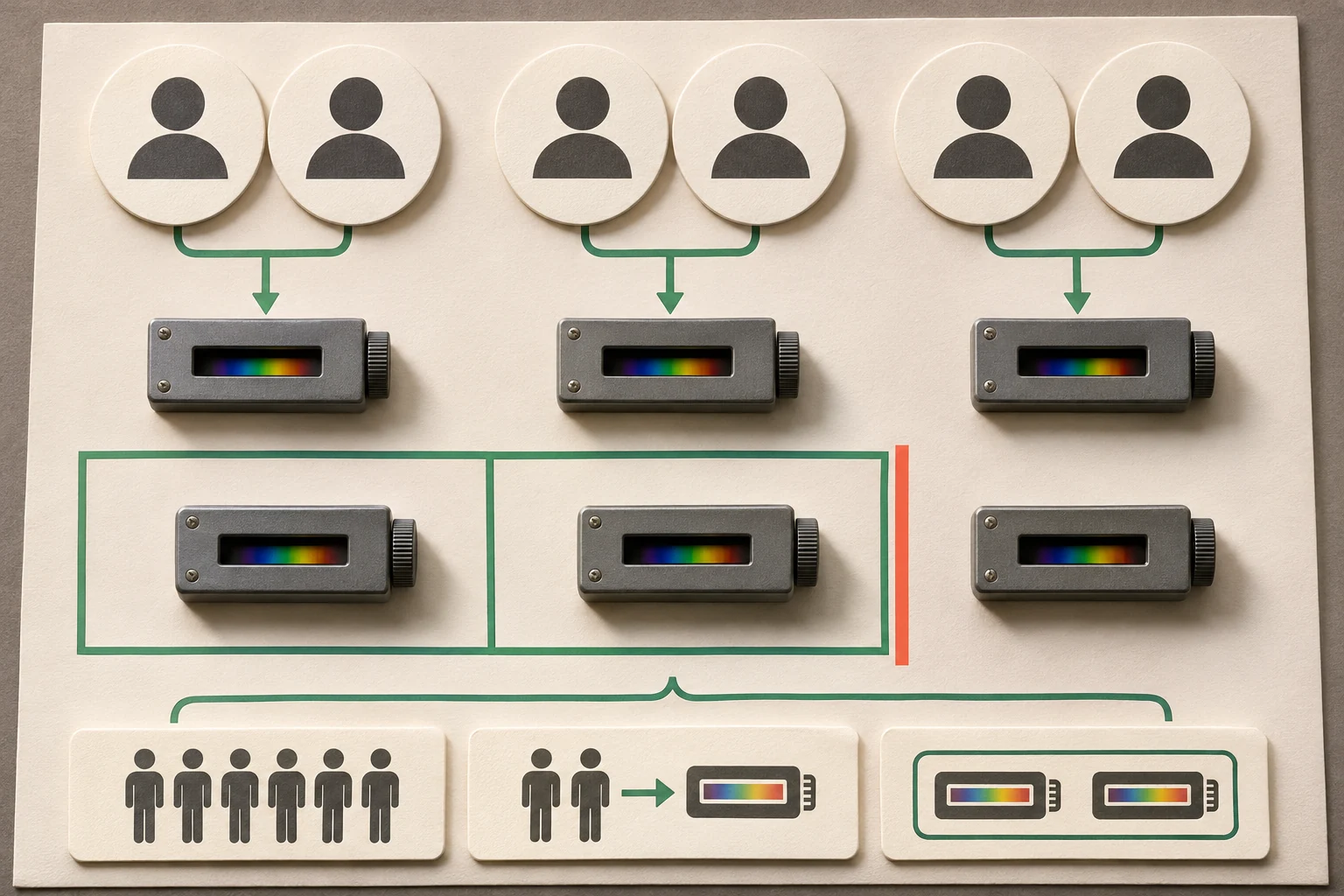
Fictional example: a coordinator is preparing an off-site workshop using pocket spectroscopes. In the program section, condition A requires all six participants to work with instruments simultaneously. In the teaching section, condition B allows no more than two participants per instrument simultaneously. In the equipment list, condition C permits no more than two instruments. A separate condition D requires a protective sleeve for every instrument.
Every pair drawn from A, B, and C is feasible. A and B allow three instruments. A and C allow six participants split into groups of three. B and C allow two successive groups of four and two participants. Instruments retain their sleeves in every arrangement.
Together, the three conditions are infeasible: two instruments accommodating at most two participants each allow a maximum of four people to work simultaneously. The requirement for six is violated. The sleeve condition plays no part in this proof.
Ask AI to identify the necessary set
Example request: “Find a set of mandatory requirements that cannot all hold simultaneously. Identify them and explain why. Then remove each condition from that set in turn and give a concrete feasible arrangement for the remaining conditions. Preserve their meaning. If a check fails, leave the conclusion open.”
In a working copy, remove a condition only when the remaining set is still demonstrably infeasible. Otherwise restore it. An uncertain outcome leaves the check unfinished. Verify every argument from the model separately.
Recursive Online Enumeration of All Minimal Unsatisfiable Subsets defines an incompatible set whose every single-condition deletion makes the remainder compatible. This is minimality by inclusion, which guarantees neither the shortest conflict nor the only conflict in the document.
Verify the explanation with diagnostic variants
In a diagnostic copy without A, six participants attend in two successive groups: four people, then two, using the same two instruments. Without B, six participants can share two instruments in groups of three. Without C, three instruments accommodate two participants each. These arrangements test the remaining conditions of the selected triple.
Check every arrangement manually against the original wording. Sleeves can remain in all three cases. If the model merely states that “the conflict disappears after deletion,” request participant assignments and instrument counts: a concrete arrangement is easier to refute or confirm than a general conclusion.
Next, prepare a diagnostic copy in which C permits three instruments. The expected outcome is feasibility of all conditions: six people work in pairs. Separately remove only D: the original numerical conflict should remain. These are expected answers for an illustrative check, not results from actual model runs.
Agree on changes and preserve the limits of the conclusion
Give the document owner the original requirements and verified explanation. This example allows discussion of a third instrument, a smaller simultaneous group, or a different participant limit per instrument. AI cannot determine which compromise is authorized: that depends on the workshop’s goals and approved requirements.
After agreement, recheck the complete set, including conditions outside the conflict record. Resolving one identified conflict does not exclude others. Clarify the change’s meaning too: permission to use a third instrument does not establish its actual availability on the workshop date.
The 2024 ContraDoc study found difficulties with contextually complex contradictions among the models tested then. It does not evaluate current models. A large set of connected restrictions may require formal verification by a specialist; translating natural language into formal conditions also requires checking.
Retain three statuses: feasible with a verified example, infeasible with verified reasoning, and undetermined. CP-SAT makes a comparable distinction between proven infeasibility and an unknown outcome. AI’s failure to find a solution does not prove that none exists.