What to ask the model to do
A procedure can appear clear while allowing work to stop after a particular event: the next step requires a document that can no longer be attached. You can ask Claude Opus 5.5 to examine this before implementation. The practical result is a sequence of permitted actions leading to a blocked state and a small rule change that restores a path to completion.
Anthropic describes this exact version as a model for sustained coding and knowledge work, including complex engineering tasks. It lists a million-token context window and a maximum output of 128,000 tokens. These describe capacity, rather than proving error-free analysis. The approval review below is our proposed method of applying the model.
The approach suits editorial procedures, packaging approvals, or submissions returned for revision. Start with a small process you can check manually. No paid model runs were performed for this article: the prompts are illustrative, and the expected deadlock follows directly from the fictional rules.
Prepare the complete rules
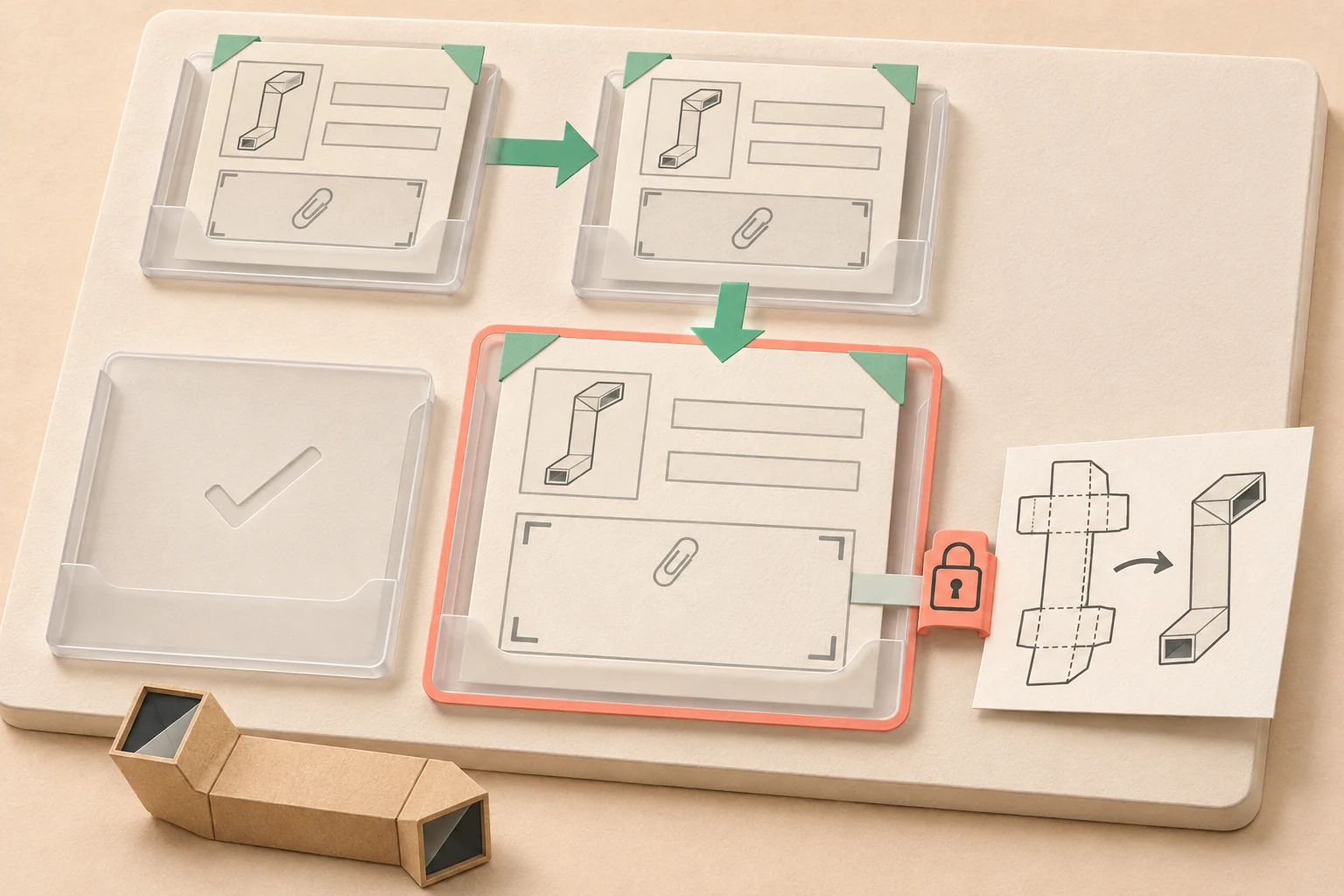
Fictional example: a team approves a printed insert for a cardboard periscope kit. There are four statuses: draft, review, revision, and approved. The author can attach artwork only in draft. Submission for review is allowed from draft or revision but requires attached artwork. The initial state is draft without an attachment.
During review, the editor either approves the insert or returns it for revision and removes the previous attachment. Approved is the only terminal status. For this example, the action list is exhaustive: there is no return to draft, cancellation, or other transition. For a real procedure, its owner must first confirm that completeness.
Give the model action conditions, responsible people, and attachment changes alongside status names. Prepare fields for each rule: starting status, artwork present, action, condition, resulting status, and artwork present afterward. Otherwise, the answer could silently introduce a convenient transition that staff cannot actually perform.
Two example prompts
First example prompt: “Below is the complete insert approval procedure. Represent permitted actions as separate records with conditions and data changes. Find a reachable unfinished state with no permitted actions. For each case, show a route from the initial state and the rule supporting every step. Do not add actions absent from the procedure.” Then supply the example rules.
The expected route is: the author attaches artwork in draft, submits it for review, and the editor returns it for revision, removing the attachment. Submission is now impossible because artwork is missing. Attaching replacement artwork is also impossible because uploads are allowed only in draft. This is the expected manual analysis, not an observed model response.
Second example prompt: “For the confirmed deadlock, propose changing exactly one rule. Preserve the prohibition on submission without artwork and mandatory editorial approval. Show a path to completion after the change and an action that must remain forbidden. If one change is insufficient, explain why.” This establishes verifiable boundaries for the proposed repair.
Check the repair manually
In this example, allowing the author to attach artwork in revision as well as draft is sufficient. After a return, the author adds a replacement, resubmits, and the editor can approve it. Submission without an attachment remains forbidden. Simply allowing submission without artwork would violate the original requirement and fail acceptance.
Draw the four statuses and track attachment presence separately. There are eight theoretical combinations, but some are unreachable under the rules. Follow permitted transitions from the initial state. For every reachable unfinished combination, find at least one path to approval. The terminal approved status having no further actions is not an error.
Repeat both direct approval and return for revision. Separately attempt the forbidden submission without artwork. Keep the supporting rule beside each transition check. A path to completion does not guarantee eventual completion: the editor could repeatedly request revisions. Waiting for a staff member’s response also does not, by itself, constitute a logical deadlock.
Available SeaGenera settings
In SeaGenera, select anthropic/claude-opus-5.5 in Playground or use the /v1/chat/completions API. Text rules are sufficient here. The catalog lists text, images, and files as inputs, with text output. Generating images or video is outside this model’s output capabilities here.
For an initial review, you can explicitly select high through reasoning.effort. This is a suggested starting point, not a tested optimum. SeaGenera lists low, medium, high, xhigh, and max, defaulting to high. Anthropic documents a different default: medium. Effort affects token consumption; judge increases by correctly identified routes.
Set max_tokens explicitly. The /docs.js table defines it as the total output limit, including reasoning; max_completion_tokens is an alternative name, and both should not be supplied together. Claude Opus 5.5 reasoning cannot be disabled. Use effort to control its depth; even low does not disable reasoning.
This version does not support forced tool calls despite tool_choice appearing in the catalog. Ordinary functions are executed by the client application, not SeaGenera. Anthropic’s fast mode and computer use are unconfirmed in the supplied SeaGenera snapshot. Neither is needed here: the output is a textual process map.
Cost and limits
Text analysis costs combine input and output tokens at separate SeaGenera ruble rates per token. Account for each additional review separately. Check current rates in the model card and on /pricing. For a small procedure, request the transition map first; a lengthy paraphrase rarely helps verify the deadlock.
Playground shows a reserve before submission. After completion, the confirmed cost is charged and the unused reserve returned. Missing usage.cost_rub does not mean a free request. An answer truncated by its budget cannot count as a complete review: narrow the process or reconsider the budget while retaining the acceptance criteria.
The model may miss transitions, invent actions, or examine unreachable states. Analysis covers only supplied rules: concurrent editors, deadlines, and external events need separate descriptions. Accept the result only after reproducing the original deadlock and manually checking the repaired process. Success on this illustrative example would not establish reliability across arbitrary procedures.


