Define the decision the summary should support
A summary can be accurate sentence by sentence yet unsuitable for a decision: benefits remain, while an unfinished test disappears. To detect omissions, work from the source towards the summary and ask which essential questions its reader can no longer answer.
First define the text’s purpose, recipient, and length. For example, a manager needs a short testing overview to decide whether new packaging is ready for transport. Development history can stay in the full report; information that changes the readiness decision belongs in the overview.
The 2021 QuestEval paper evaluates summary content through questions and answers. Below is an independent editorial procedure inspired by that idea. It produces a register of retained and missing information; it does not calculate the research metric.
Develop questions from the source
Freeze the source version and number its sections or paragraphs. Without showing the model the summary being checked, ask it to suggest questions relevant to the intended decision. Each question needs an answer from the document and its exact supporting location. Check these suggestions manually.
The Pyramid study starts from the idea that there is no single best summary and considers the importance of individual units of meaning. In our procedure, the editor decides what this recipient must know. Frequent repetition in the source does not automatically make a fact essential.
Ask narrow questions: what did testing reveal, what remains unknown, and under what condition is the option recommended? Each question should check one piece of information. Mark essential questions separately from background details. Review every section heading manually: the model may have omitted that section’s content entirely.
Check answers without access to the source
Now give the model only the finished summary and approved questions, without the source or reference answers. Otherwise, it could answer from the full document when the summary’s reader could not. This request tests whether the shortened text is sufficient for the predefined task.
Example request: “Answer exclusively from the summary. For each answer, provide a supporting passage from the summary. If no answer is available, write: insufficient information. Do not add general knowledge or infer permission to proceed from a description of benefits.”
Compare the answers with the source and record: question, source answer, source location, summary answer, supporting passage, status, and importance. Use the statuses “retained,” “partial,” and “omitted.” If the source itself provides no answer, record a separate source gap. Adding a guess cannot resolve that gap.
Example: an exhibition equipment packaging report
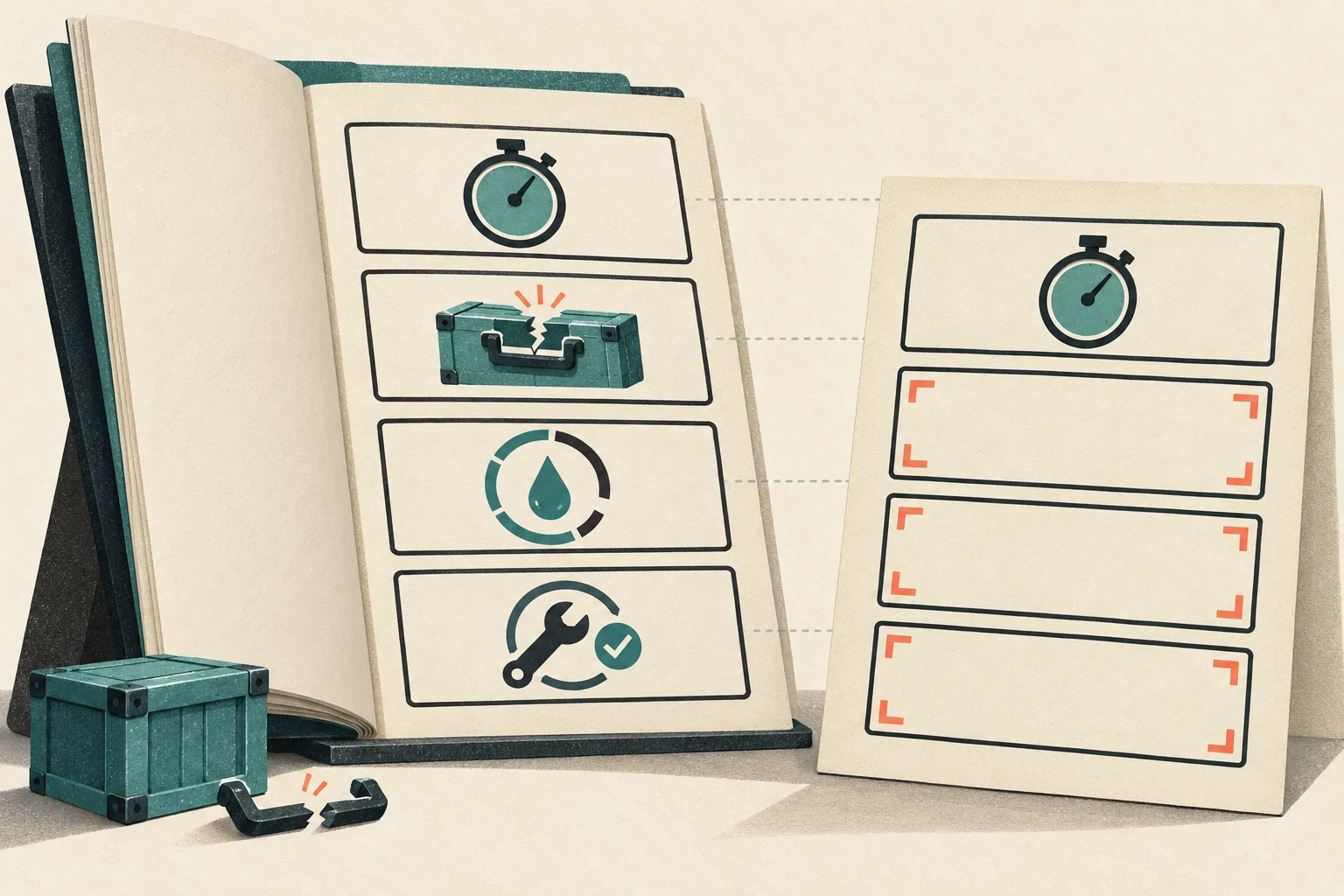
Fictional example: a report compares crates A and B for transporting exhibition equipment. Section 2 gives assembly times: seven minutes for A and four for B. Section 5 says handles broke off two of twelve tested B crates. Section 7 says moisture testing has not happened; section 9 recommends B after its handles are improved.
Example incomplete summary: “Crate B is being considered for the next shipment: assembly takes four minutes versus seven for A.” These statements are true, but only the assembly-time question is answered out of four essential questions. The handle test result, unknown moisture resistance, and condition attached to the recommendation are missing.
Example revision: “Crate B takes four minutes to assemble; A takes seven. Handles broke off two of twelve tested B crates; the report recommends B after the handles are improved. Moisture resistance remains untested.” The damage count describes those tests; it cannot support a forecast for future shipments.
Verify the result through an independent reading
To verify the result, ask a colleague to answer the same questions using only the revised summary. Then compare the answers with the source together. Check meaning rather than matching words: “recommended after improvement” and “ready for transport” lead to different decisions.
Count answered essential questions separately and list those still unresolved. In our fictional example, the initial text retains one answer out of four; the revision retains all four. This describes coverage of the selected questions, not an overall quality percentage. Count background details separately.
Before release, reread changed sentences: restoring an omission might introduce a new unsupported claim. For this procedure, require every essential question to have a supported answer or an explicit statement that the information is unknown. If everything cannot fit, increase the length or narrow the summary’s purpose and approve the questions again.
Understand the limits of the check
The checking model can also miss information. The 2024 Lost in the Middle study found that information position affected the studied models’ performance on question answering and key–value retrieval; the middle of long contexts was often difficult. This does not measure every current model’s quality or test this procedure.
If the document is too long, develop questions section by section, preserving definitions, notes, and references to adjacent sections. Then combine the questions and remove duplicates. Do not base the check solely on intermediate summaries: information lost during the first shortening may never become a question.
This procedure checks completeness against a purpose and question list, not the source’s truth. Faulty text recognition, a missing table, or an inaccurate report requires separate work with the original. Review the questions when the recipient, task, or document version changes; previous approval does not transfer automatically.


