Separate an accepted job from a dispatched request
An editor needs one product description while background processing already has dozens of items to handle. If the application immediately sends every job to a model, both streams compete for available resources. If it silently holds everything, the person cannot tell whether generation has started or whether cancellation is still possible.
Microsoft’s Queue-Based Load Leveling guidance describes a queue as an intermediate buffer: jobs arrive independently of processing speed. The practical implication for an AI application is to make job acceptance and the request to the model two separately observable events.
Create a job record containing its identifier, initiator, work type, acceptance time, and state. Record dispatch time separately. A “Waiting for dispatch” message should mean that no AI API request has been made. This register makes cancellation testable and helps explain the current stage to the user.
Set two capacity boundaries
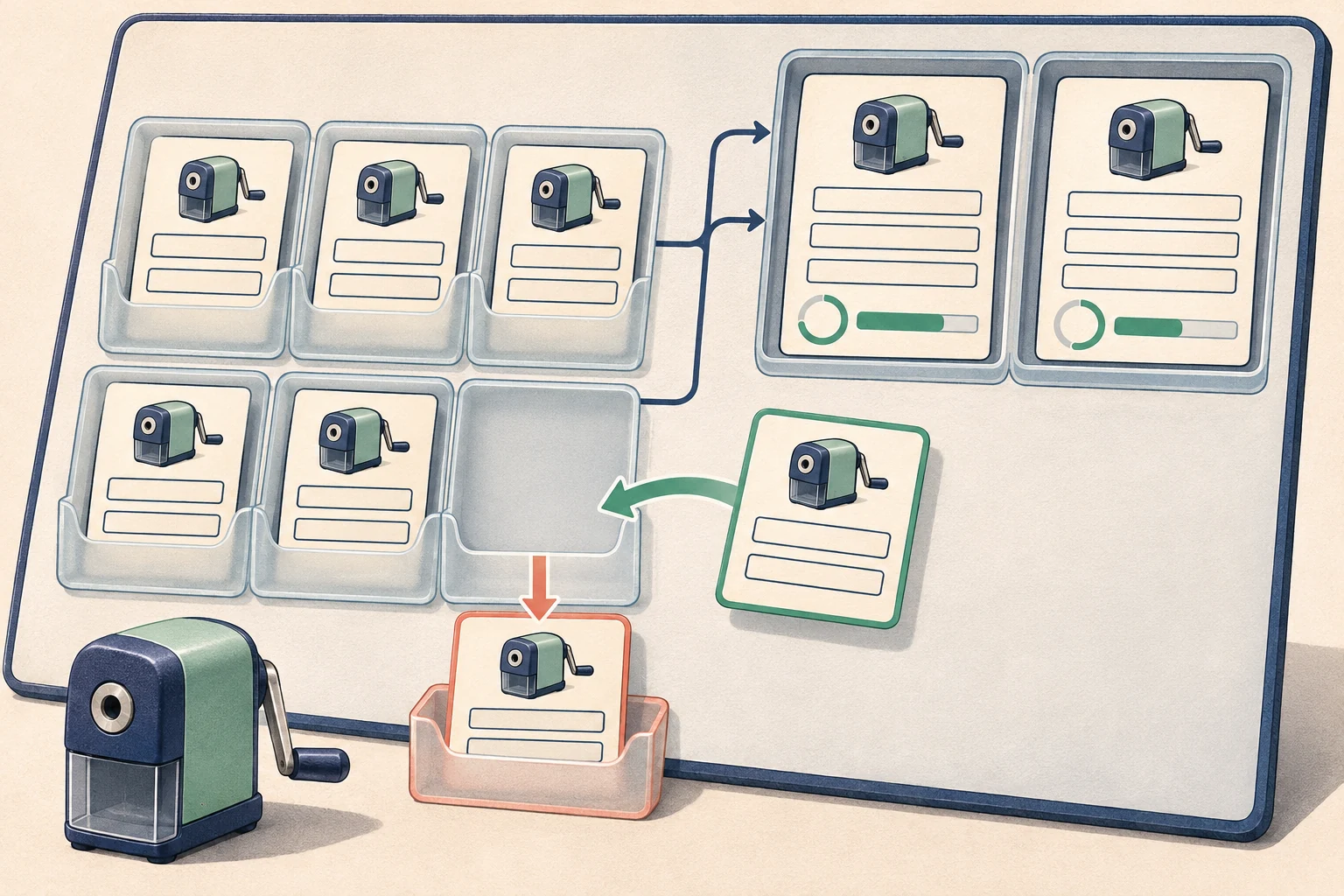
Here is a fictional example: an application generates descriptions for a hand crank pencil sharpener catalog using product specifications. Its illustrative admission rule allows two active generations and six waiting records. These numbers are example settings, not SeaGenera limits or a recommendation for every project.
When both execution slots and all six waiting slots are occupied, the application declines the next submission. It preserves the user’s input and explicitly reports that the job was not accepted. It must not confirm that a job has been queued when no space remains.
Coordinate capacity checks and slot allocation across all workers. Otherwise, two workers could both see the final available slot. Set a separate dispatch rate limit: even short, sequential generations can exceed the permitted request count over a period, despite only one running at a time.
Define how the next record is selected
The example has two job types: an interactive revision of one description and background catalog preparation. The application assigns the type from the workflow. Letting users arbitrarily mark every job urgent would undermine assistance for the editor actually waiting for an on-screen result.
Microsoft’s Priority Queue guidance warns that continuously selecting only high-priority messages can postpone other work indefinitely. Our illustrative rule is this: when both types are waiting, after at most three interactive starts, give the next start to the oldest background record. Preserve acceptance order within each type.
Check the rule using four simulated slot releases: with enough records available, three interactive jobs and one background job should start. Do not interrupt an active generation to achieve this. If both slots contain lengthy jobs, a new interactive record still waits; priority determines the next start without guaranteeing an immediate answer.
Confirm cancellation only at a known boundary
For a waiting record, cancellation prohibits future dispatch. Once confirmed, the application releases the waiting slot and retains a cancellation record. Deleting the record entirely makes verification harder: a reviewer cannot readily distinguish cancellation from a lost job or reconcile the accepted workload.
Cancellation and the transition to “Dispatching” must compete to update the same record: only one change can win. If cancellation is confirmed first, the worker skips it. If the worker has already claimed it for dispatch, the interface reports that cancellation before dispatch can no longer be confirmed. Disappearing from the screen proves nothing.
MDN describes AbortController as a way to interrupt a fetch request, response consumption, or stream. This client-side action does not confirm that generation was canceled without charges. SeaGenera’s documentation separately warns that stopping can still incur costs. Closing the connection alone should therefore not release a slot counted as an active operation.
Rehearse the check without calling a model
Start with an empty register and paper records. For this scenario, assume the rate limit permits dispatches and no responses have arrived. Add eight background jobs: two should become active and six should wait. Decline the ninth submission; it does not count as an accepted job.
Cancel one waiting record, leaving five. Add a new interactive record, filling the sixth waiting slot. No additional dispatch should occur until an active job finishes. This tests the different consequences of releasing a waiting slot and releasing an execution slot.
Simulate completion of one active job and start the interactive job; its priority counter starts at zero in this check. The nine accepted records now comprise one completed, two active, five waiting, and one canceled. Separately reverse the order of cancellation and claiming: a cancellation confirmed before claiming must prevent dispatch under either worker interleaving.
Check the limits of this approach
A queue absorbs bursts but cannot resolve a sustained processing shortfall. Microsoft notes that the queue grows when jobs arrive faster on average than they are processed. Track both waiting count and the age of the oldest record. Six slots bound the backlog but promise nothing about waiting time.
The queue described here belongs to your application. According to SeaGenera documentation retrieved on November 6, 2026, account limits are shared by the website and all its API keys. Your dispatcher coordinates only requests passing through it. Account separately for concurrent Playground use and other applications when choosing your operating margin.
The paper exercise evaluates the rules. Test the implementation with a test handler that logs dispatches and returns simulated completions without calling a model. Repeat with two workers running simultaneously. Passing does not establish queue persistence after a restart or assess product description quality; those require separate tests.


