How one word changes a conclusion about a group
When AI condenses workplace correspondence, check words such as “all,” “some,” “only,” and “none” separately. A statement about part of a batch can become a conclusion about the entire batch. That shift can change a reader’s decision even when the objects and overall situation are described correctly.
Reconstruct which group a statement concerns and what it establishes about its members. For example, “not all are functional” establishes that at least one object is faulty. By itself, it neither identifies that object nor gives the exact number of functional objects.
Scope Ambiguities in Large Language Models (2024) examines how models handle sentences with multiple possible scopes for semantic operators. The editorial implication is to check the selected interpretation separately. The record proposed below is an independent procedure, rather than a reproduction of that paper’s experimental protocol.
First establish the group and the property
Start with a brief description of the source message. Record the group’s members, its size, the property being checked, and the limits of the inspection. “All inspected easels” and “all easels in the workshop” can refer to different sets. If AI silently expands the set, its subsequent reasoning addresses a different task.
Next, establish which outcomes the author distinguishes. An object might be functional, faulty, or not yet inspected. If inspection is incomplete, a missing positive result cannot automatically count as a detected fault. Before calculating numerical bounds, establish whether the stated outcomes cover every possibility.
Restate the important phrase in simple terms without strengthening it. “At least one” does not specify an exact number. “Some” does not say precisely how many objects are involved either. If a practical decision requires an exact count, flag the need for clarification instead of inserting a convenient number.
Example: a note about six easels
Fictional source example: “Six easels have been inspected: A, B, C, D, E, F. Each locking mechanism was classified as either functional or faulty. Not all six have functional locking mechanisms. Those on A and B are functional. The individual results for the others are not included in this note.”
The note establishes a minimum of two and a maximum of five functional easels. There is at least one faulty easel and at most four. At least one faulty easel belongs to C, D, E, and F. The note cannot establish which one: their individual results are unavailable.
An example of an incorrect AI answer is: “Two easels are functional; the remaining four are faulty.” This turns a confirmed minimum into an exact count. Another incorrect answer is: “Easel C is faulty.” Here, the model assigns a group property to a specific object without evidence. Both answers add unsupported information.
Request a conclusion record before the final message
Example prompt: “Check conclusions about the number of functional easels using this note. State the group’s members, possible inspection outcomes, confirmed individual results, and minimum and maximum counts of functional and faulty easels. Explain the bounds. Separately list which individual results cannot be established. Then draft a short message for the organizer.”
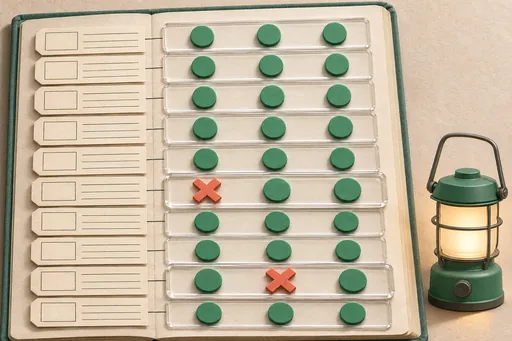
The expected record includes all six identifiers. Only A and B are individually confirmed as functional. The bounds are two to five functional easels and one to four faulty easels. The individual results for C, D, E, and F remain undetermined from the note.
Check each bound manually. Two functional easels are explicitly confirmed. “Not all” rules out six, setting the maximum at five. The same phrase requires at least one faulty easel. There cannot be more than four faulty easels because A and B are functional. These explanations must agree with one another.
Test the conclusion using compatible arrangements
Construct several sets of results that each satisfy the source. In the first example arrangement, only C is faulty; in the second, only D is faulty. All other objects are functional. Both arrangements are permitted. Therefore, “C is faulty” is not a necessary consequence of the note: the second arrangement provides a counterexample.
Now suppose C and D are both faulty: the note permits this too. Consequently, “exactly one is faulty” is also unproven. Finally, suppose all four of C, D, E, and F are faulty. Together with the single-fault arrangement, this demonstrates that both numerical endpoints in the record are achievable.
CONDAQA (2022) evaluated negation understanding using paraphrases, changes to negation scope, and negation reversal. The procedure here uses an independent check through compatible arrangements. Its purpose is to find at least one situation consistent with the source that disproves an overly strong AI claim.
What to accept and where to stop
Accept the result when the group is preserved, the bounds are justified, and individual objects receive no unsupported results. Then reread the final message: a correct intermediate record does not prevent an error during shortening. For this example: “A and B are functional; there are faulty easels among the others, but the note does not identify them.”
The procedure depends on a clear source. “Not all passed inspection” might refer to failed results or incomplete inspection. The example removes that ambiguity by explicitly defining two outcomes and stating that all six objects were inspected. In real correspondence, find that basis or ask the author.
A few successful analyses do not establish reliability across documents, languages, and phrasings. This check also does not establish whether the objects actually function: it evaluates only what follows from the note. The practical result is a message with justified precision and a clear account of the information still needed.