Why the number of links can be misleading
AI prepares a brief claiming that five sources confirm a product feature. You open the pages and find the claim in all five. Yet a shop may have copied the manufacturer’s manual, a roundup may have used the shop’s description, and another review may have used the roundup. Assessing the conclusion requires tracing where each publication obtained its information.
NIST’s generative AI risk profile describes confidently presented errors, including fabricated explanations and citations. The model’s own explanation of source independence therefore needs checking too. Persuasive wording and a long list of addresses cannot replace a traceable origin for a specific claim.
The practical result is a small map showing which documents contain an original statement or personal observation, which repeat other materials, and which have an unknown origin. Start with one claim that affects your text. Checking key conclusions individually is usually easier than investigating an entire brief at once.
Map one specific claim
Write the claim on a separate line, preserving the object, version, and conditions: for example, whether a particular container’s divider can be removed without tools. General descriptions of convenient construction are too vague. For each page, record its address, author or organization, date, relevant passage, stated evidence, and relationship to another publication.
W3C’s PROV Model Primer describes provenance through materials, activities, participants, and relationships showing how one material derives from another. For editorial work, a simple record is enough: publication B uses manual A. Add the evidence for that relationship, such as a direct link, attribution, or another available indication.
Assign a status to each claim within a page. An author might test a device personally while copying its dimensions from a manual. Different domains and author names do not establish independence. Matching phrases can reveal possible borrowing, but without additional evidence the relationship should remain a hypothesis.
An illustrative mosaic container example
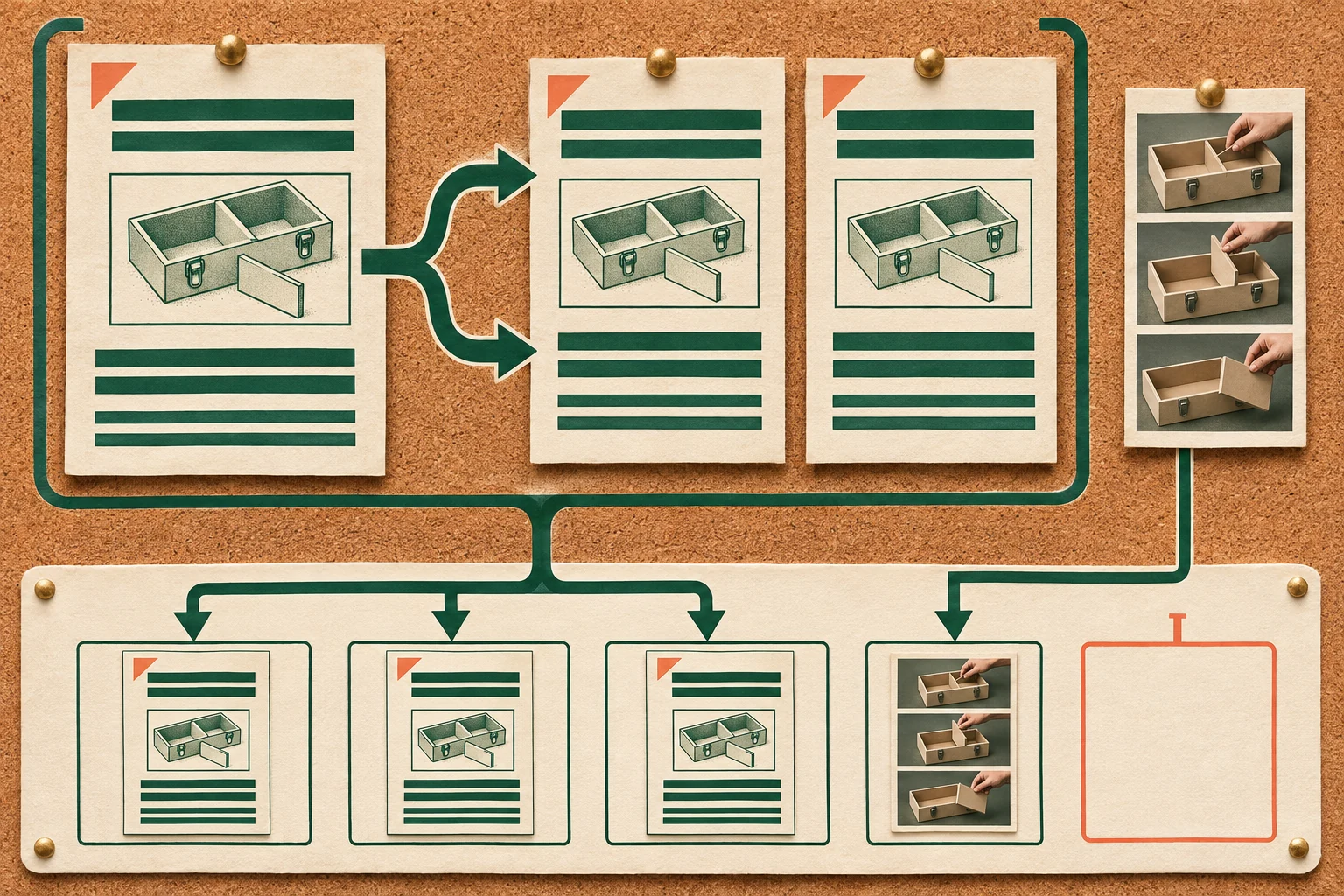
Fictional illustrative example: an editor checks whether a tabletop mosaic container’s divider can be removed without tools. All documents and observations in this example were invented for this explanation. Manual A makes the claim. Shop B repeats it and links to the manual. Roundup C cites the shop.
Review D describes the author’s own check of the same container version with two side catches. It shows sequential photographs of divider removal, identified as the author’s photographs. Catalog E makes a similar promise without explaining its source. The map connects B to A and C to B; the origin of E’s claim remains unknown.
Five publications therefore contain a traceable manufacturer statement and a separate observation by a reviewer. Two other pages repeat the statement, while one needs further investigation. The brief can say that the manufacturer promises removal without tools and that a reviewer demonstrates it on the tested unit. Five independent tests would be an unsupported description.
Ask AI to group sources with supporting evidence
A text model in SeaGenera’s Playground can help draft groups from prepared excerpts. Label each excerpt and retain its source information. If the model receives only excerpts, restrict its conclusions to their contents: a page address alone does not show that the page was opened and read.
Example request: “Using materials A–E, map the origin of the divider claim. Support every relationship with a passage. Separately list original statements, descriptions of personal observations, retellings, and unknown origins. Do not infer borrowing from textual similarity alone. Then suggest a conclusion that preserves these distinctions.”
Check the proposed relationships manually. A manual link may support dimensions while the adjacent divider claim comes from elsewhere. Likewise, an original photograph of the closed container does not establish that its author tested divider removal. Every relationship needs evidence concerning the selected claim.
Check the map by removing republications
Copy the collection and remove shop B and roundup C. In the example, the evidence remains manual A, observation D, and E’s unknown origin. Manually check that the final wording preserves the same evidential scope. If using a model again, assess the meaning rather than whether its wording matches.
Next, temporarily remove review D. Only the manufacturer’s statement and E’s claim of unknown origin remain. The conclusion should lose its reference to a separate check. If that reference survives, the map or final text contains an error. Adding a translation of manual A cannot restore the missing observation: its statement retains the same origin.
Ask a colleague to reconstruct the relationships using only your map and saved passages. Acceptance requires evidence for every established relationship, explicit unknowns, no stronger conclusion after removing republications, and a corresponding textual change after removing a separate observation. This check requires no new generations.
Preserve the limitations in the finished brief
Google’s fact-checking guidance calls for traceable analysis, transparent sources and methods, and references to primary sources. This provides a useful editorial principle: readers should understand who made the statement, who described a personal check, and what uncertainty remains after review.
The map has limits. It shows available relationships without proving the absence of hidden borrowing, shared materials, or staged photographs. Different provenance chains can also contain errors. If pages cite each other in a circle, mark the circular chain and continue looking for evidence outside it.
Check provenance independence and factual truth separately. Even a described observation concerns a particular unit and version. Check a second AI model’s agreement against its evidence too: it may use the same publications. Before release, retain the map, access dates, and exact conclusion so another editor can repeat the check.