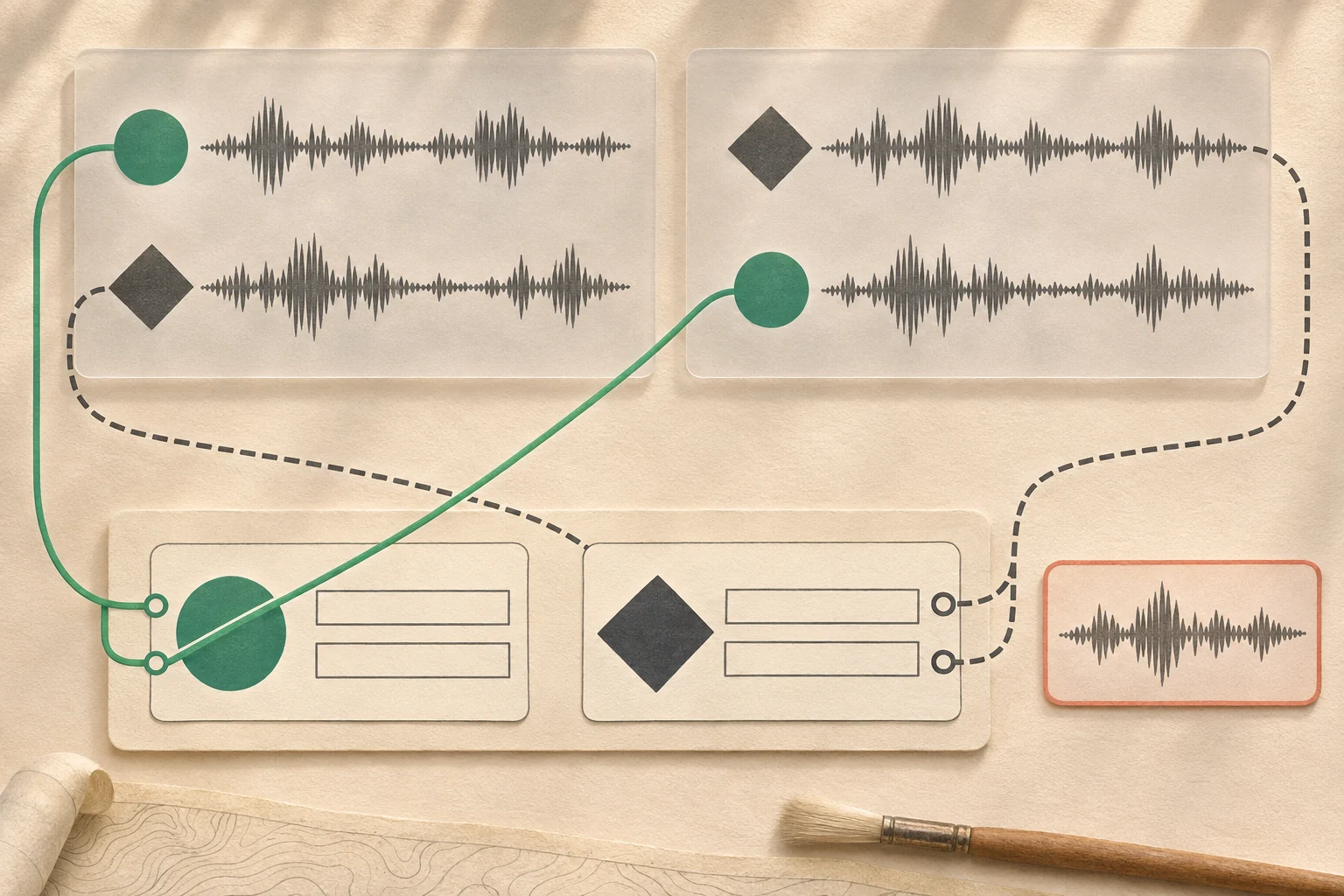
Why matching numbers need checking
Two parts of a conversation may be transcribed separately and then assembled into one document. Automatically replacing every “speaker 1” with the first participant’s name can give different people the same attribution. This changes authorship even when the words were recognized correctly.
Microsoft describes a speaker identifier as a generic label assigned during recognition. Google’s reference defines a speaker label within a particular audio recording. These definitions suggest an editorial rule: matching numbers in independent results do not, by themselves, establish that the person is the same. This is a verification rule, not a claim that every system necessarily renumbers participants.
The practical deliverable is a shared participant register linked to verified utterances. It supports attribution in the combined text and lets a reviewer revisit the evidence for each name. Keep the original local labels alongside the editorial names.
Preserve the origin of every utterance first
Give each source file a separate identifier, such as A or B. Preserve the returned transcript before renaming speakers. In the working copy, every utterance should retain its file identifier, original label, and location in the recording. Missing timestamps can be replaced with an interval located manually.
Prepare register fields for file, local label, verified interval, shared participant, evidence, and status. Three statuses are useful: confirmed, unresolved, and conflict. Combining the file identifier with the label prevents accidental merging of matching numbers from different results.
In SeaGenera, detailed responses preserve timestamps and speaker fields when the provider returns them; diarization depends on the selected model’s parameters. Check the fields actually received. Maintain the mapping register separately: a detailed transcript does not itself create a shared participant list across several files.
An example with swapped numbers
Consider a fictional example: two separately recorded parts of a conversation about restoring a paper map. In file A at 00:08, Irina introduces herself and receives the label “speaker 1.” At 00:21, Anton introduces himself with the label “speaker 2.” These passages become the initial reference excerpts.
In file B, the numbers are assigned differently. At 00:06, “speaker 1” says, “I’ll photograph the edges with side lighting.” At 00:18, “speaker 2” says, “We’re keeping the existing backing.” The example assumes that listening against the reference excerpts and obtaining participant confirmation establishes Anton as the first speaker and Irina as the second.
The correct register contains four mappings: A and the first label to Irina; A and the second to Anton; B and the first to Anton; B and the second to Irina. A job title, an utterance’s subject, or the order in which names appear cannot replace verification. Mentioning photography does not itself establish that Anton is speaking.
Check whether an entire label can be renamed
Before replacing a label throughout a transcript, listen to several separated utterances carrying it. For a short recording, you might select its early, middle, and late appearances. Also check brief replies and interruptions. This is a proposed editorial sampling procedure, not an established standard of sufficiency.
If one label contains two different people, mark a conflict. Replacing that label with a single name would spread the error throughout the document. Correct individual intervals while retaining the original label, or leave disputed utterances without a personal attribution until clarified.
The reverse situation also needs evidence: two different labels may belong to one participant. Merge them only after comparison with verified reference excerpts. Where speech overlaps, preserve both distinguishable utterances and mark the overlap; do not assign the entire passage to one person merely to make the formatting tidy.
Check the finished document independently of the numbers
After applying the register, select several utterances from each file and trace them backward: final attribution, register entry, source interval, listening. For quotations, agreements, and personal commitments, check every utterance being used. A general sample does not establish authorship for an unchecked passage.
Run a manual test on copies of the materials. Swap the local numbers in the second file and update the corresponding register entries at the same time. Names in the combined text should remain unchanged. Changed attributions reveal that assembly uses a number without sufficiently connecting it to its source.
Next, temporarily remove one confirmed mapping. Utterances depending on it should become unresolved rather than inherit a neighboring participant’s name. Count remaining unresolved cases and conflicts separately. Having no unresolved cases is useful only when every name actually has verified supporting evidence.
Limitations and handing over the result
Google’s reference describes confidence as an estimate of recognized-word correctness; it may be absent and does not guarantee accuracy. A high value therefore cannot establish a speaker’s identity. Correct wording, a correct local label, and a correct mapping to a name each require their own supporting evidence.
Similar-sounding voices, brief replies, and overlapping speech can leave attribution unresolved even after repeated listening. If a reference excerpt is insufficient, seek participant confirmation or retain a neutral label. This editorial procedure is not intended to establish an unknown person’s identity from their voice.
Hand over the final text, mapping register, and list of unresolved intervals together. State which passages were reviewed completely and which were sampled. After a file is transcribed again, recheck its mappings: the previous register belongs to the previous result, even when the source recording has not changed.


