A task to give the model
Mistral Large 4 accepts text and images and returns text. Its developer’s Hugging Face card confirms image analysis, reasoning, and tool use. In SeaGenera’s catalog, its identifier is mistralai/mistral-large-4-0. One practical scenario is matching a written parts list against a photograph of components laid out before assembly.
The output should be a record showing each required part, how many instances are visible, what prevents verification, and what additional observation is needed. This approach suits preparing workshop kits, packing small sets, and reviewing customer photographs. It helps organize an inspection while leaving final confirmation to a person.
The example below is fictional. The prompts and expected entries illustrate a procedure; they are not outputs from actual model testing. No paid generations were performed for this review. The focus is the specific ability to connect requirements with observable objects, without claiming that the model outperforms alternatives.
Prepare the layout and an independent reference
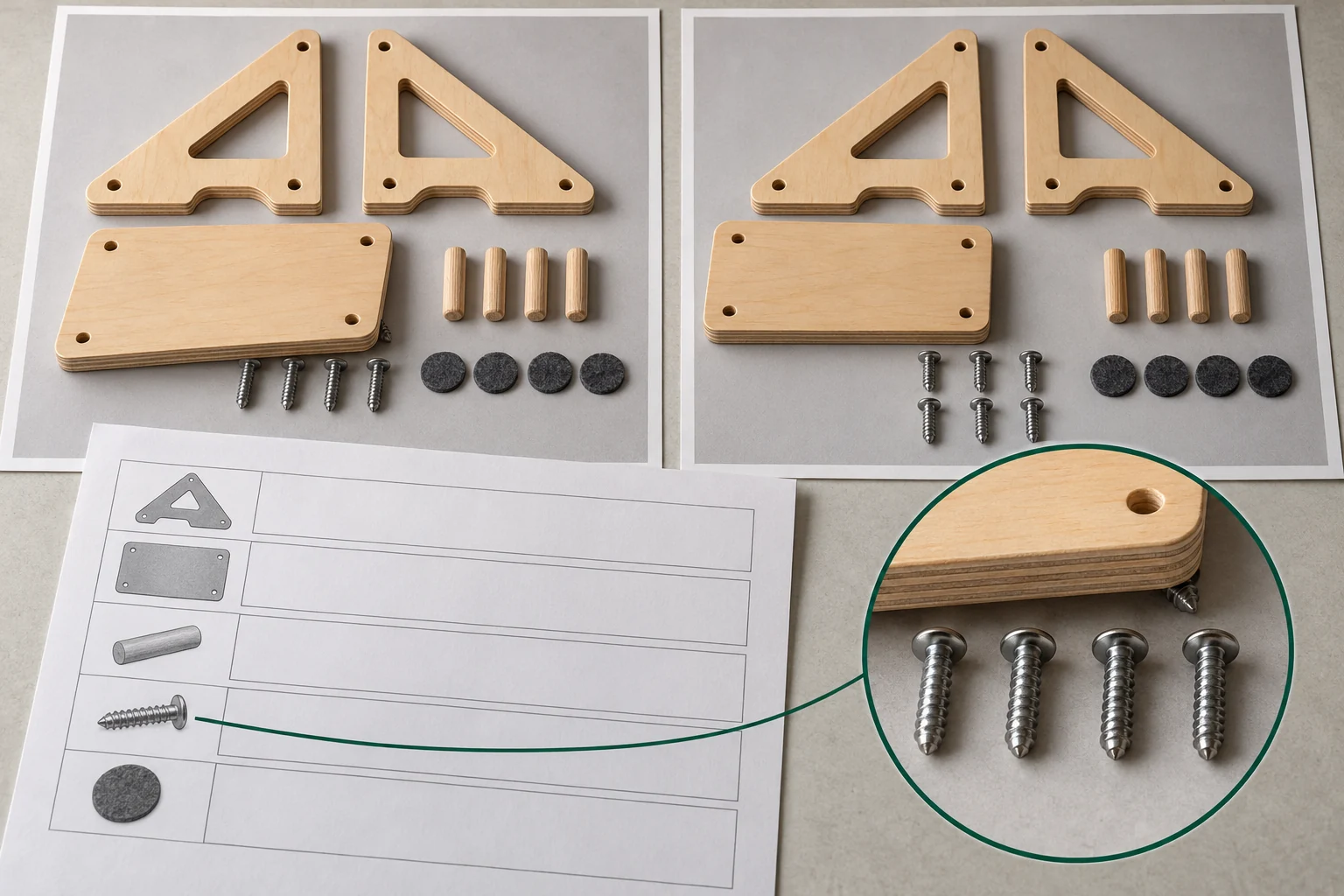
Example: a wooden book stand kit contains two triangular side panels, one rectangular shelf, four wooden dowels, six screws, and four felt pads. Before photographing it, a person counts the components and records the actual contents separately. Keep that record for checking the answer, without including it in the prompt.
Arrange the objects against a plain background, separate similar components, and remove unrelated items. Supply the list as ordinary text: name, required quantity, and distinguishing feature. If screws differ in length, describe this separately and provide distinguishable examples; their dimensions should not be guessed from photographic perspective.
In this example, all six screws are physically present, but the shelf’s edge conceals one in photograph A. This is a deliberately constructed example condition. The photograph’s reference assessment must reflect visibility: five screws are visible, while this angle does not confirm the sixth.
First prompt: separate observation from conclusion
Example prompt: “Compare attached photograph A with this kit list: two triangular side panels, one rectangular shelf, four dowels, six screws, and four felt pads. For each item, report the required quantity, clearly visible count, location, and obstacle to verification. Do not treat an obscured area as evidence that a part is absent. If a quantity cannot be confirmed, explain why and suggest another angle. Do not declare the kit complete while any items remain unverified.”
Example of a correct entry for this condition: “Screws: six required; five clearly visible; the area beneath the shelf’s edge is obscured; completeness cannot be confirmed from this photograph.” This is an assessment criterion. Both “one screw is missing” and “the sixth is definitely beneath the shelf” go beyond the observation.
A second angle and verification
For photograph B, the fictional example moves the shelf aside, revealing the sixth screw while retaining the other components. Example follow-up prompt: “This is another view of the same kit. Compare photographs A and B. Update only items for which additional observations are available. Identify which photograph supports the count. Do not count the same objects in different views as separate instances.”
Check every entry by locating the corresponding objects in the photograph and counting them yourself. Pay particular attention to dowels beside screws, touching pads, and components near the frame boundary. Each accepted entry should clearly identify the visible instances supporting it and their locations.
In your review log, separately record false confirmations of completeness, unsupported shortage claims, and double counting across views. Also compare against the preliminary physical count. Success on this photograph pair establishes a result only for this example; crowded layouts, glare, and different component shapes require separate checks.
Settings available in SeaGenera
This scenario suits SeaGenera’s text Playground and API, using text and an image as input. Disable masking when using an attachment: a key with mandatory masking will reject the request. The photograph should be clear enough for a person to verify the same features you ask the model to find.
Set max_tokens explicitly: this limit includes reasoning. Through response_format, you can select text or supported JSON Schema output. An ordinary inspection record is convenient initially; for application use, a structure keeps fields consistent but does not establish that the count is correct.
SeaGenera’s catalog snapshot dated October 30, 2026 lists high and none. The developer describes low, medium, and high, while Hugging Face warns that none still results in high in the Transformers implementation. Keep high for this scenario. These sources do not confirm low or medium availability, or actual reasoning deactivation, in SeaGenera.
The model supports tool calls; SeaGenera provides tools and tool_choice, while the client application executes functions. This inspection requires no tools. The selected model outputs text; this mode does not produce a corrected photograph.
Cost and practical limits
Cost is calculated from input and output tokens at separate ruble rates per token. The catalog lists a separate rate for confirmed cache reads; do not automatically apply it to every repeated request. Check current rates in the model card and on /pricing before submitting.
SeaGenera reserves an amount first, then charges the confirmed cost and returns the unused remainder. Attachment reserves can substantially exceed the final charge. When planning a two-angle inspection, account for each request and revision. Keep the prompt, photographs, and inspection record together so the result can be reviewed again.
A photograph does not confirm material, strength, precise dimensions, or a sealed package’s contents. The model can also misidentify or miscount visible components. Accept the record after manually checking every required item; where coverage is incomplete, the practical output is a specific request for further observation. Physical completeness requires inspection.


