What work to give the model
OpenAI positions GPT-6.1 Sol for complex coding, document work, and multi-step processes. According to its developer model page, it accepts text and images and produces text; audio and video inputs are unsupported. Here, we examine schedule preparation, where dependencies between operations must be reconciled with one person’s availability.
This scenario is useful when preparing a small production batch, demonstration, or materials for collection. The practical deliverable is an operation record containing start times, finish times, and reasons for those choices. The following is an independent workflow: no paid model runs were made, and the prompts and calculations are not responses obtained from GPT-6.1 Sol.
Prepare the work specification
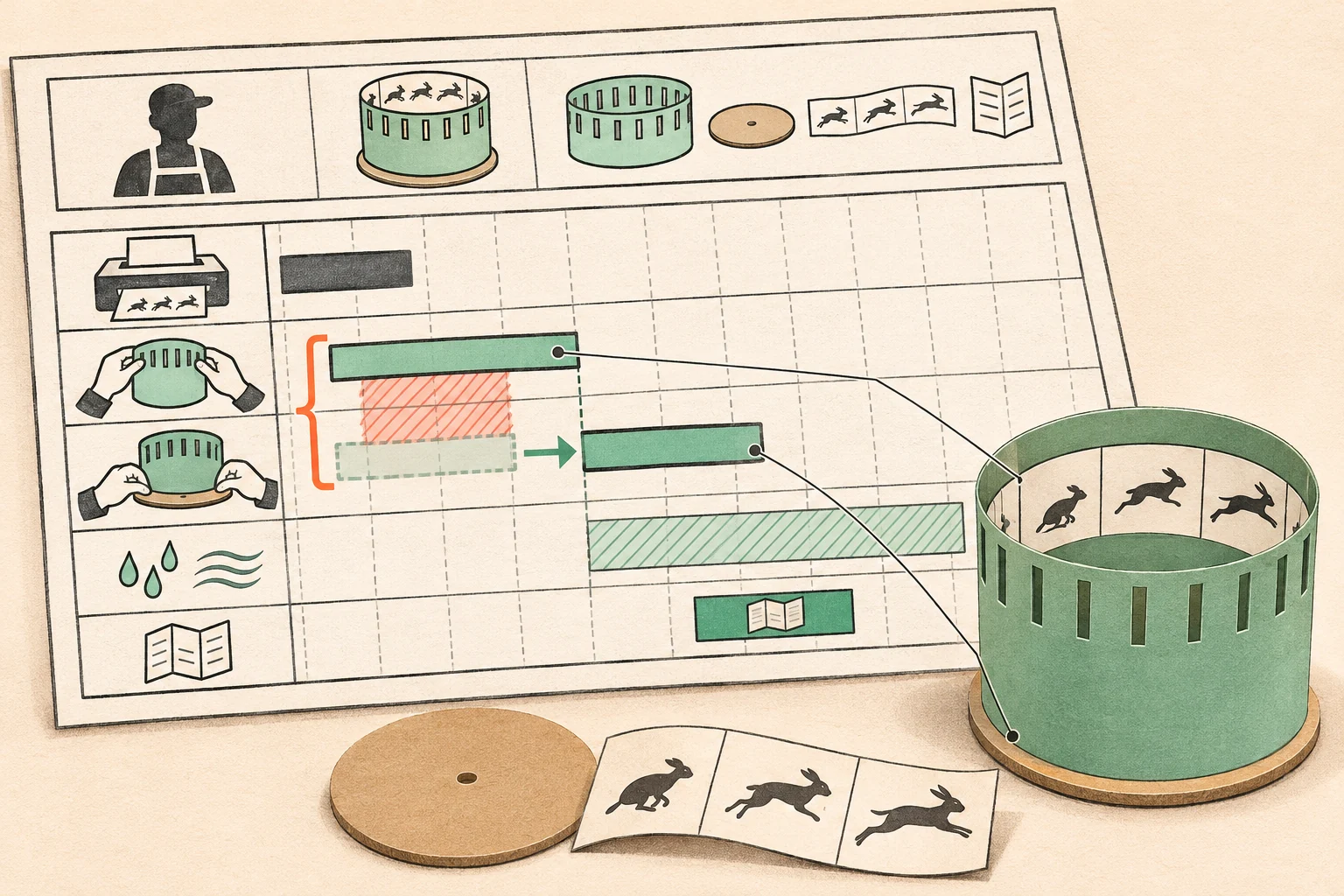
Fictional example: a workshop assembles paper zoetropes, rotating slotted drums containing illustrated strips. Work starts at 10:00, with collection at 11:45 that day. Every duration covers the entire batch. Operations are indivisible, there are no breaks, and material transfers are already included in the durations.
Operation A is automatic strip printing, taking 20 minutes; the printer has already started at 10:00. B is cutting bases, requiring 25 minutes of human work. C is trimming printed strips, requiring 15 minutes of human work after A. D is gluing the drums, requiring 20 minutes of human work after B and C.
E is drying after D, taking 30 minutes without human involvement. F is packing previously prepared instruction sheets, requiring 20 minutes of human work independently of the other operations. G is the final inspection, requiring 10 minutes of human work after E and F. The printer and drying area are available; the worker is the only constrained resource. These durations are illustrative, not adhesive processing recommendations.
First prompt: obtain a feasible schedule
Example prompt: “Use the work specification above. Find the earliest completion with one worker. For each operation, give its start, finish, human involvement, and predecessors. Manual work must not overlap. Preserve every duration. Provide a short calculation showing why earlier completion is impossible, and state the margin before 11:45.”
The calculated reference for checking is: A runs from 10:00 to 10:20, B from 10:00 to 10:25, C from 10:25 to 10:40, and D from 10:40 to 11:00. E then occupies 11:00–11:30, with F inside that interval, from 11:00 to 11:20. Inspection G runs from 11:30 to 11:40. Five minutes remain before collection.
Establish the finish time independently
First check each record: finish minus start must equal the duration, and the start must follow every required predecessor. Then separately write out the intervals for B, C, D, F, and G. They occupy one person and therefore cannot overlap, even when technological dependencies permit parallel work.
Before gluing, the worker must complete B and C, totaling 40 minutes. Another 20 minutes of gluing, 30 minutes of drying, and 10 minutes of inspection are unavoidable. The lower bound is 100 minutes after 10:00. The reference schedule reaches it because F fits within drying. To check the procedure itself, deliberately start C at 10:20: it must detect the overlap with B until 10:25.
Second prompt: examine a delay
Example second prompt: “Change only C’s duration from 15 to 25 minutes. Recalculate the schedule and earliest completion. Preserve one worker, the dependencies, and drying. State the deviation from the 11:45 deadline. Present any proposed changes to the original conditions separately as options requiring approval.”
The new calculated reference is 11:50, five minutes late. Manual work before gluing now requires 50 minutes; adding gluing, drying, and inspection gives 110 minutes. Packing the instructions still fits within drying. Reject an 11:45 plan if the model silently shortens drying or adds a helper. A possible revised deadline of 11:50 requires separate agreement.
SeaGenera settings and boundaries
The catalog lists the model in SeaGenera Playground and API. Plain text output is sufficient here. The November 21, 2026 snapshots of /docs and the /docs.js parameter table confirm max_tokens and its alternative name max_completion_tokens: supply one of them. The limit includes reasoning. Allow room for the schedule and its checks; an interrupted answer cannot be accepted.
Available reasoning.effort levels are low, medium, high, xhigh, and max; medium is the default. Disabling reasoning with none is unsupported for GPT-6.1 Sol. OpenAI’s guide also excludes temperature and top_p when reasoning is enabled. Keeping medium is a reasonable starting configuration; increasing the level does not establish that a schedule is correct.
There is a material discrepancy: OpenAI requires the Responses API for this model’s tool calls, while SeaGenera’s published documentation describes tools through Chat Completions. The SeaGenera snapshot does not document a Responses API. Tool calling for this model through SeaGenera’s published interface therefore cannot be treated as confirmed. This scenario uses text, without connecting a calendar or executing functions.
Cost and acceptance conditions
SeaGenera calculates charges in rubles from processed input and output; the catalog separately lists cache read and write rates and a large-input tier. Their presence does not guarantee caching for your request. Before submitting, check current terms in the model card and on /pricing. The displayed reservation differs from the final confirmed charge.
Accept the schedule after checking durations, dependencies, worker availability, and the completion lower bound. In a real workshop, add verified setup times, breaks, and necessary buffers. The model can overlook a constraint or make arithmetic errors; OpenAI cautions that its challenging factuality evaluations do not represent ordinary error rates. Larger production plans require separate verification; this example does not establish model reliability on other schedules.


