Suitable tasks
OpenAI: GPT Audio Mini accepts text and audio and can return text and speech. Images and video are unsupported. Here, the task is drafting a short spoken customer reply from a supplied reference note. Suitable scenarios include support drafts and spoken explanations when the product and permitted actions are already described.
As of November 19, 2026, OpenAI marks gpt-audio-mini as deprecated and lists January 20, 2027 as its API shutdown date. A SeaGenera catalog listing does not promise availability beyond that date. All examples below are illustrative: no paid generations or quality measurements were performed.
Prepare a note for one question
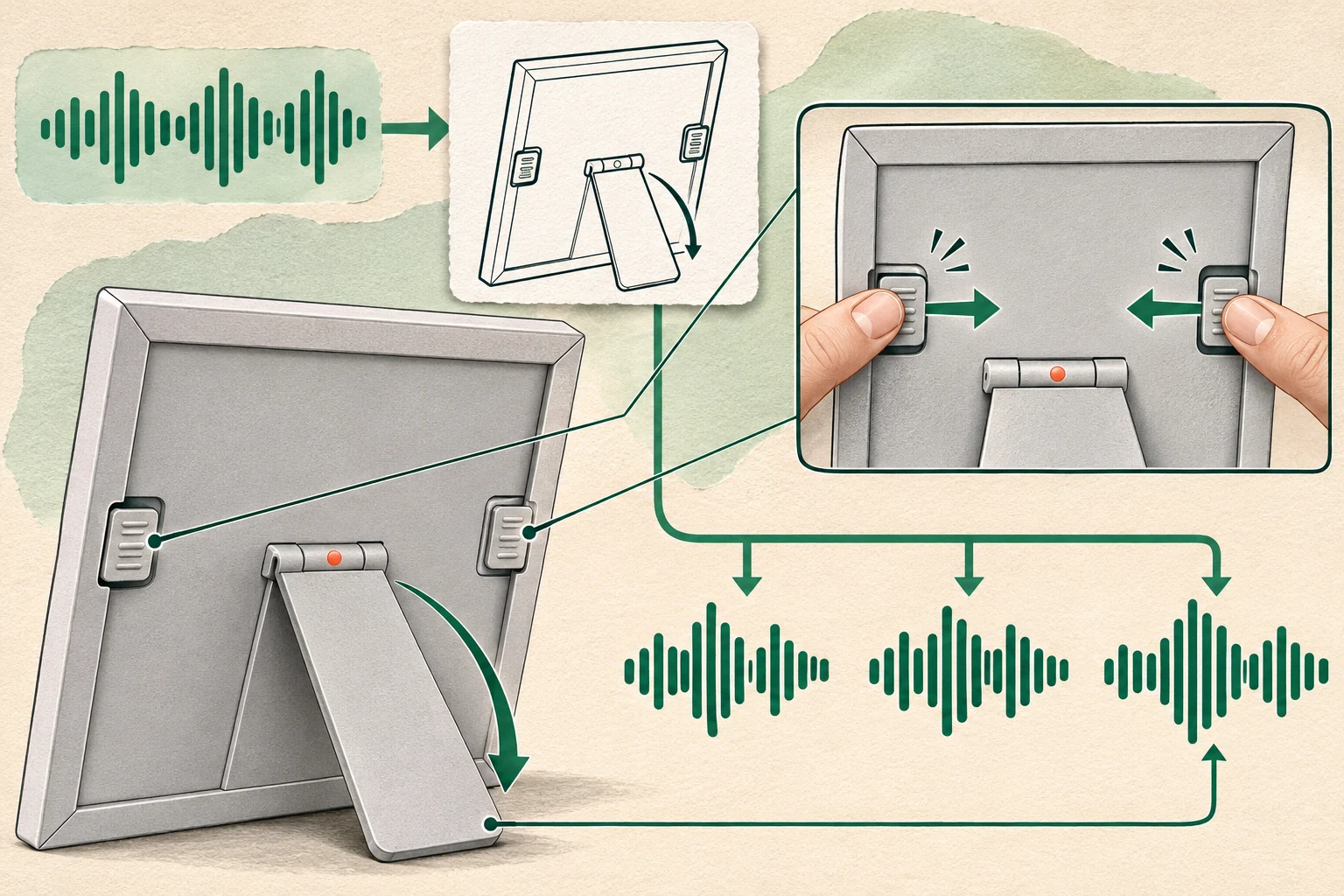
Fictional example: a shop sells a tabletop poster frame. Its approved note says: squeeze both side clips simultaneously, then fold the rear support backward. If a clip is cracked, do not set up the frame; hand it to staff. No replacement procedure is provided.
The customer’s recording says: “I want to stand the frame on a table. The support won’t move. Should I pull harder?” Explain the first action without diagnosing a fault. Keep the note, recording, and expected meaning separately. Add no assumptions about what the customer already tried.
Two example requests
First example, with text input: “Use only the attached frame note. The customer asks, ‘The support won’t move; should I pull harder?’ Produce a spoken answer in Russian, in no more than three short sentences. Explain the first action and what follows. Do not diagnose a fault or add repair methods.” Place the note after these instructions.
Second example, with audio input: “Listen to the attached question. Answer briefly using the note below. If a key word is unclear, ask one clarifying question instead of guessing. Do not read production instructions aloud.” Attach the recording and same note. Transcribing the question alone does not complete the task.
Illustrative answer: “First, squeeze both side clips simultaneously. Then fold the support backward. You do not need to pull harder.” This editorial example shows the intended meaning; it is not model output. Requesting three sentences does not guarantee compliance.
SeaGenera settings and boundaries
The November 19 SeaGenera documentation snapshot confirms Playground and API access. The model ID is openai/gpt-audio-mini. For a completed audio response, /v1/audio/generations documents text input, an input_audio recording or messages containing history; settings include voice, max_tokens, and response_format. Six voices are listed: alloy, echo, fable, onyx, nova, shimmer. Example starting settings are alloy, WAV, and max_tokens 512; they do not guarantee duration.
A field in supported_parameters does not guarantee audio-method support. OpenAI marks Structured Outputs unsupported. History does not make a request a continuous voice call. Streaming documentation conflicts: SeaGenera describes it for GPT Audio while OpenAI’s exact Mini page marks it unsupported. Here, use a completed file.
Check where the answer came from
Check relevance and grounding separately. The main answer must name simultaneous squeezing of both side clips, followed by folding the support backward. Repeating the question, saying “be careful,” or suggesting a button fails, however convincing the voice sounds.
Next control example: keep the recording unchanged and substitute a clearly labeled training note for a different design, where a central button releases the support. The expected answer now changes to the button. Continued instructions about two clips show failure to follow the replacement note. Keep the voice, question, and other conditions unchanged.
Also prepare an example recording asking how to replace a cracked clip. The original note supports referring the customer to staff; invented repairs fail. Record whether each answer addresses the question, gives the correct action, and adds unsupported details. One successful answer does not establish reliability.
Review the spoken result
Listen to the actual final file. If a text response is returned, compare it with the speech, but do not substitute reading for listening. In “both side clips,” the number and location must remain clear; “simultaneously” must describe squeezing. Check for truncation, unnecessary introductions, and spoken production instructions.
Ask someone else to demonstrate the action on a safe training mockup or describe it after one listen. Record their first movement. Investigate misunderstanding even if every word is present. The model cannot see the actual frame: its answer cannot establish that the listener has this design.
Cost and acceptance
SeaGenera accounts separately for input and output text and audio tokens. Catalog rates are per token, not per million tokens or per second of recording. Check current rates in the model card and on /pricing, and review the reserve before submitting. Confirmed cost is charged, and unused reserve returns after reconciliation.
For a modest first trial, use one short question and a compact note, with checks defined beforehand. Each new generation is charged separately. Fix content before comparing voices. Accept the reply after checking it against the note and listening. For ongoing use, account for the announced shutdown and retain evaluation examples independently of the model.


