First decide what must be new
A classifier may label test messages correctly because you already examined almost identical requests during development. Different rows do not necessarily represent independent cases: an email, its follow-up, and a paraphrase may describe one episode. Before evaluation, decide which new cases you want the results to apply to.
Google’s machine learning course warns about duplicates shared between training and testing. It also explains that repeatedly adjusting a system using the same test results gradually fits it to that test’s peculiarities. For a classifier based on a pretrained language model, we propose applying this principle to instruction and example development.
Separate materials by purpose. Demonstration examples enter the model’s prompt; a development evaluation set helps improve the instructions; a closed final test evaluates the selected version. This does not require training model weights. The practical deliverable is three record lists, with a clear reason for each record’s assignment.
Build a register of related records
Official scikit-learn documentation describes group-based splitting: related observations from one group should not appear in both training and evaluation. Applying this approach to customer requests is the procedure proposed here. The unit assigned to a partition becomes the original episode together with all its derived records.
For each record, include a message identifier, episode identifier, source record for derived versions, group identifier, intake channel, reference category, and assigned partition. Add a brief grouping reason, such as continuation of the same conversation. These administrative details serve the reviewer; include them in classifier input only when the operational task requires them.
Sharing a category does not itself make messages one group. Two independently received rental extension requests can remain separate cases. Conversely, translating or editing one email preserves its connection to the source. Categories within an episode may also differ; that is no reason to split the episode across partitions.
Illustrative example: hand trolley rental
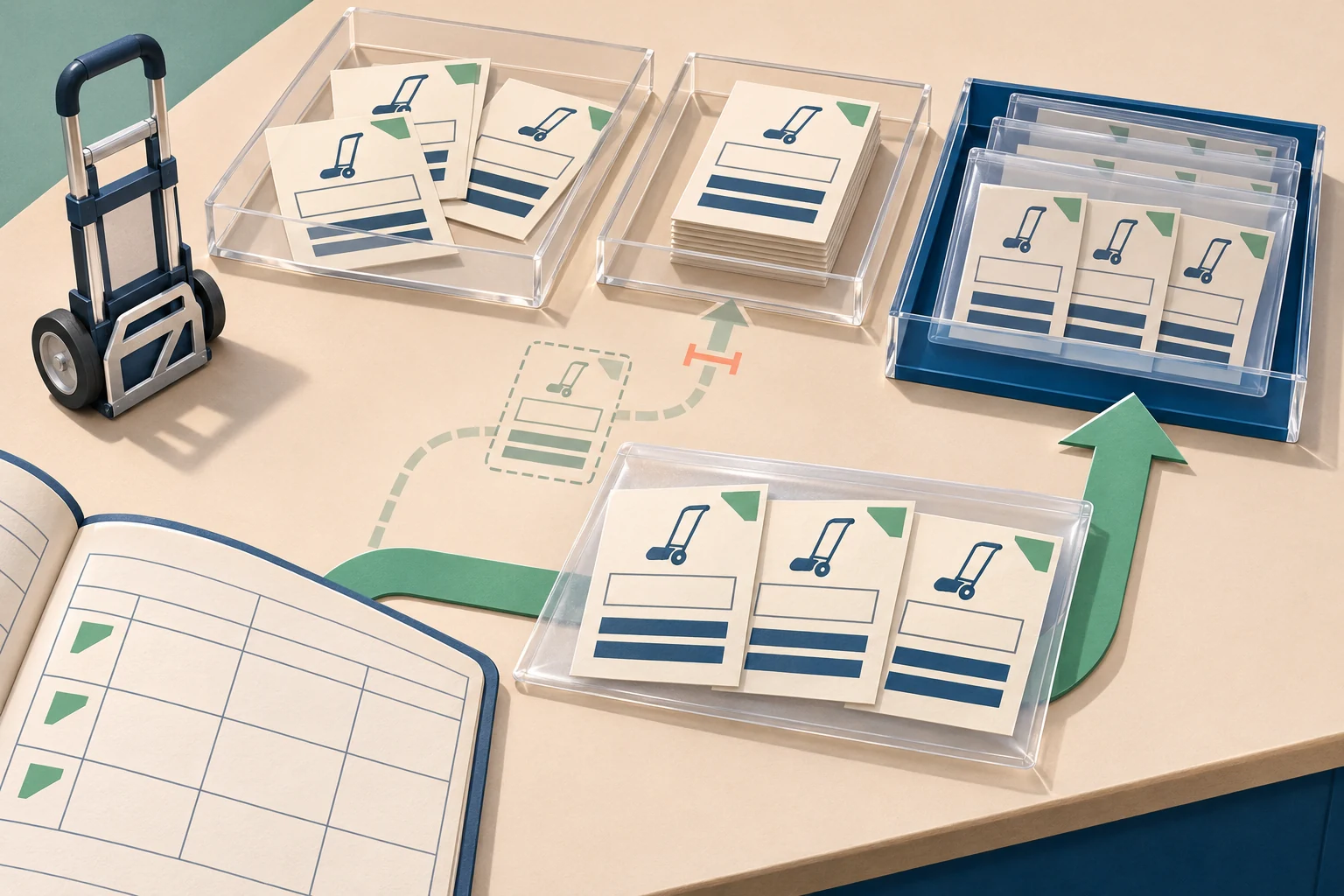
Consider a fictional rental service whose classifier distinguishes collection rescheduling, rental extensions, and damage reports. Its illustrative dataset contains 72 messages from 24 original episodes, with three records per episode. Every request and number in this example is fictional; no model was run on this dataset.
One episode contains the original request, “Extend my trolley rental until Friday,” a follow-up, “Can I return the trolley on Friday instead of Thursday?” and an edited paraphrase of the first message. All three receive one group identifier. Putting the original in demonstrations and the paraphrase in the final test would make evaluation partly depend on an already examined case.
For this example, assign 12 complete groups to demonstrations, six to development evaluation, and six to the final test. This produces 36, 18, and 18 messages respectively. These proportions are illustrative, not universal recommendations. Another renter’s extension request may enter the final partition if its origin is genuinely independent.
Audit the split before contacting a model
Assign complete groups first, then inspect each partition’s composition. Check that required categories and intake channels are present. If a category has only one episode, distributing its messages cannot create an independent evaluation. Record the shortage and collect additional cases instead of artificially increasing the row count.
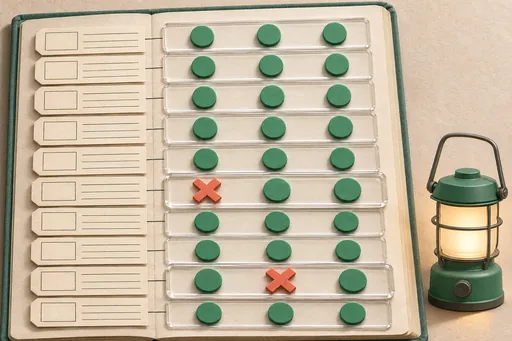
In a small spreadsheet, perform three checks: repeated group identifiers, matching text, and similar messages sharing a source. When searching for matches, temporarily disregard extra spaces and letter case while preserving originals. Keep negations, numbers, and dates visible: they can change meaning rather than merely presentation.
Ask a separate reviewer to audit final records’ origins without revealing their contents to the instruction author. For our example, readiness requires all 72 records to appear exactly once, every group to have one assignment, and no source records shared between partitions. Document a reasoned decision for every suspicious match.
Freeze the version and define how the test is used
Before final evaluation, retain the model designation, instructions, demonstrations, category rules, available settings, and dataset version. Record what qualifies as a correct answer and which errors are unacceptable. This establishes exactly which system was evaluated if the prompt or message processing rules change later.
After evaluation, report both message count and original group count. Our final partition contains 18 messages but only six episodes. In the error log, preserve both connections: the individual record and its group. This reveals whether several errors concern one case or occur across different independent requests.
If a final-test error inspires an instruction change, that dataset has participated in developing the new version. Keep it for checking known failures, recording its new purpose. Prepare fresh groups for the next independent evaluation. Do not move difficult records between partitions to obtain a higher final score.
Limitations and the completed review package
Hugging Face distinguishes evaluation on a static dataset before deployment from observation during actual operation. Our split concerns the former. It helps evaluate prepared data but does not establish performance on future requests containing different vocabulary, new services, or revised category rules.
Group boundaries depend on the evaluation question. Testing performance on new customers may require combining different episodes from each customer. Testing new episodes from familiar customers makes that grouping a stricter question. Choose and document the boundary beforehand. This procedure also cannot prove that a provider never used similar text during model training.
The completed package contains the provenance register, three record lists, a log of disputed connections, and the evaluated version’s specification. The final manual check is simple: a colleague selects any final record and explains its origin, assignment, and lack of related development records. If this requires guesswork, repair the register before evaluating the classifier.