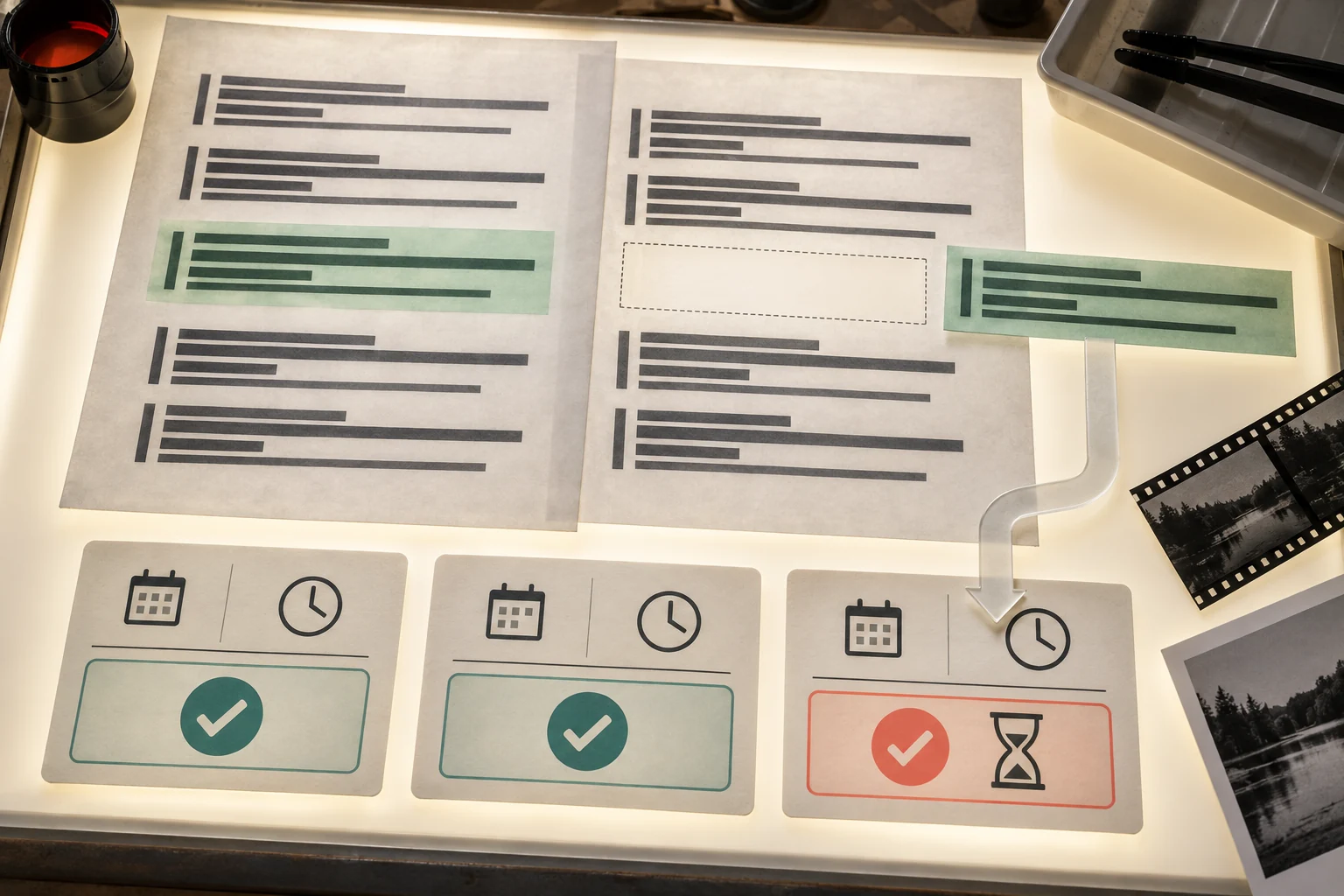
Ask a question about one block
A working prompt gradually accumulates explanations, repeated prohibitions, and examples. To decide which passage can be removed, compare the original version A with version B, which omits exactly one block. The result will be a decision record: remove it, keep it, or extend the evaluation.
Record the candidate block’s purpose: which behavior it should produce and when that behavior matters. Saying “the rule seems unnecessary” is too vague. A testable question is: does the shortened prompt preserve the distinction between a booking request and a confirmed booking?
First, save the exact text of both versions. When preparing B, leave all other wording, section order, and examples unchanged. If you rewrite the task while removing a rule, the comparison will reveal the combined change’s effect, but will not isolate the contribution of that deletion.
Example: confirming a darkroom booking
Illustrative example: an assistant drafts replies to darkroom visitors. Both prompts share this instruction: “Write a short reply to the visitor using the administrator’s source note. Use only information from that note. Preserve the booking’s date, time, and status. If information is missing, state what needs clarification.”
Version A adds this block: “Confirm a booking only when the administrator has explicitly confirmed it. A visitor’s request to book and an offered available time do not, by themselves, confirm a booking.” Version B removes only this block, testing whether the general instruction to preserve status is sufficient.
Example source: “The visitor requests Saturday at 15:00. The administrator offered that time but awaits the visitor’s agreement.” An acceptable reply preserves that pending agreement. Example error: “You are booked for Saturday at 15:00.” Conversely, a note explicitly confirming a booking should not become a provisional request in the reply.
Prepare cases where the rule might matter
For this example, prepare twelve distinct notes in advance: four booking requests, four confirmations, and four waiting-list entries. Record each note’s expected status and required details. This is a proposed illustrative dataset, not a report of completed tests or the frequencies found in actual traffic.
Before comparing, define the removal condition: version B must make no status errors and lose no required details across all planned attempts. Assess politeness separately. Otherwise, pleasant wording could conceal a promise of a service the visitor has not secured. Choose case numbers according to your task’s variety.
Fix the model, available generation settings, response budget, and message contents. Start a separate conversation for each attempt using identical source material. NIST describes grouping experiments under consistent accompanying conditions; the proposal here applies that principle to each note. In SeaGenera Playground, save prompt texts separately: reloading requires entering them again.
Compare attempts using identical source notes
Anthropic notes that responses vary between attempts and uses repeated trials in evaluations. For this illustrative plan, assign three attempts per version for each note. Twelve notes produce 72 responses. Three repetitions are a chosen preliminary evaluation size, rather than a universally sufficient number.
For each note, run A and B close together in time, randomly choosing which version goes first. Retain every response with its case number, prompt version, and attempt number. Record interrupted attempts separately; a successful retry must never silently replace the original unsuccessful attempt.
First, assess responses with the A and B labels hidden. Check status, date, and time against the source, noting invented promises. Reveal the version labels after grading. Each case will then have two sequences of results, such as three marks for A and three for B, explaining every error.
Base the decision on specific losses
Group results into four situations: both versions succeed, only A succeeds, only B succeeds, or both fail. Separately retain cases whose results vary across repetitions. Identical overall success totals can conceal the loss of an important behavior on particular notes.
Example possible discrepancy, not a test result: A preserves the pending status in every attempt, while B confirms the booking once. Investigate that error before replacing the prompt. Restore the deleted block and repeat the case; restored correct behavior strengthens the hypothesis that the block helps, without proving a universal causal relationship.
In the decision record, retain the deleted passage, comparison conditions, case groups, observed losses, and reasoning. If both versions fail, fix the task or source notes before shortening. If no losses appear, “candidate for a trial with human review” is an appropriate conclusion, limited to the scenario evaluated.
Check the final shortened version
Before starting, set aside additional notes with different wording, dates, and times. For example, reserve one for each of the three statuses. After deciding to remove the block, evaluate the final version on them. If these notes lead to prompt changes, another independent check requires fresh cases.
Multiple deletions introduce another limitation. NIST warns that changing factors individually does not reveal their interactions. Two similar prompt rules may partly compensate for each other. Successfully removing either one separately therefore does not automatically justify removing both: evaluate the version containing the combined deletions again.
A small error-free dataset does not establish equal reliability across all requests. Rare wording, a long conversation, or a model change can produce different results. Keep the original version and its permitted scope of use. Reducing the text alone also does not establish faster responses or lower actual charges.


