First define what counts as one product
Before looking for duplicates, write down which records may be merged. Identical names can describe different sizes, packages, or variants. If you simply ask AI to remove similar rows, the model chooses what constitutes a match. The practical output is a decision register with evidence for each pair.
For a catalog, one unit might mean the same manufacturer, full product variant, and package sold. A product family can contain several separate items. If your catalog tracks individual physical objects, you need a different rule: matching model names do not establish that two records describe the same object.
Use three outcomes: confirmed duplicate, different products, and review required. For the third, identify the missing evidence, such as a variant code that needs checking against the original document. An absence of differences does not establish identity: a short record may omit essential characteristics.
Prepare comparisons while preserving originals
Keep the original records and their permanent identifiers. Prepare comparison fields alongside them: manufacturer, full code, size, version, and package contents. Microsoft documents normalization for matching without changing source values in the final unified profile. The same separation is useful when reviewing a catalog.
In the comparison copy, you can standardize capitalization and spaces, and convert explicitly stated dimensions to one unit. Record the basis for each transformation so the original can be recovered. Preserve code endings and package designations: a short suffix may identify a distinct variant. Leave ambiguous abbreviations for manual review.
For a small catalog, first select candidate pairs using manufacturer, product family, or distinctive words. Then ask AI to assess each pair against your identity rule. Keep the reason each candidate was selected: this helps reveal duplicates that never reached comparison because their names contained errors.
Example: four bench vise records
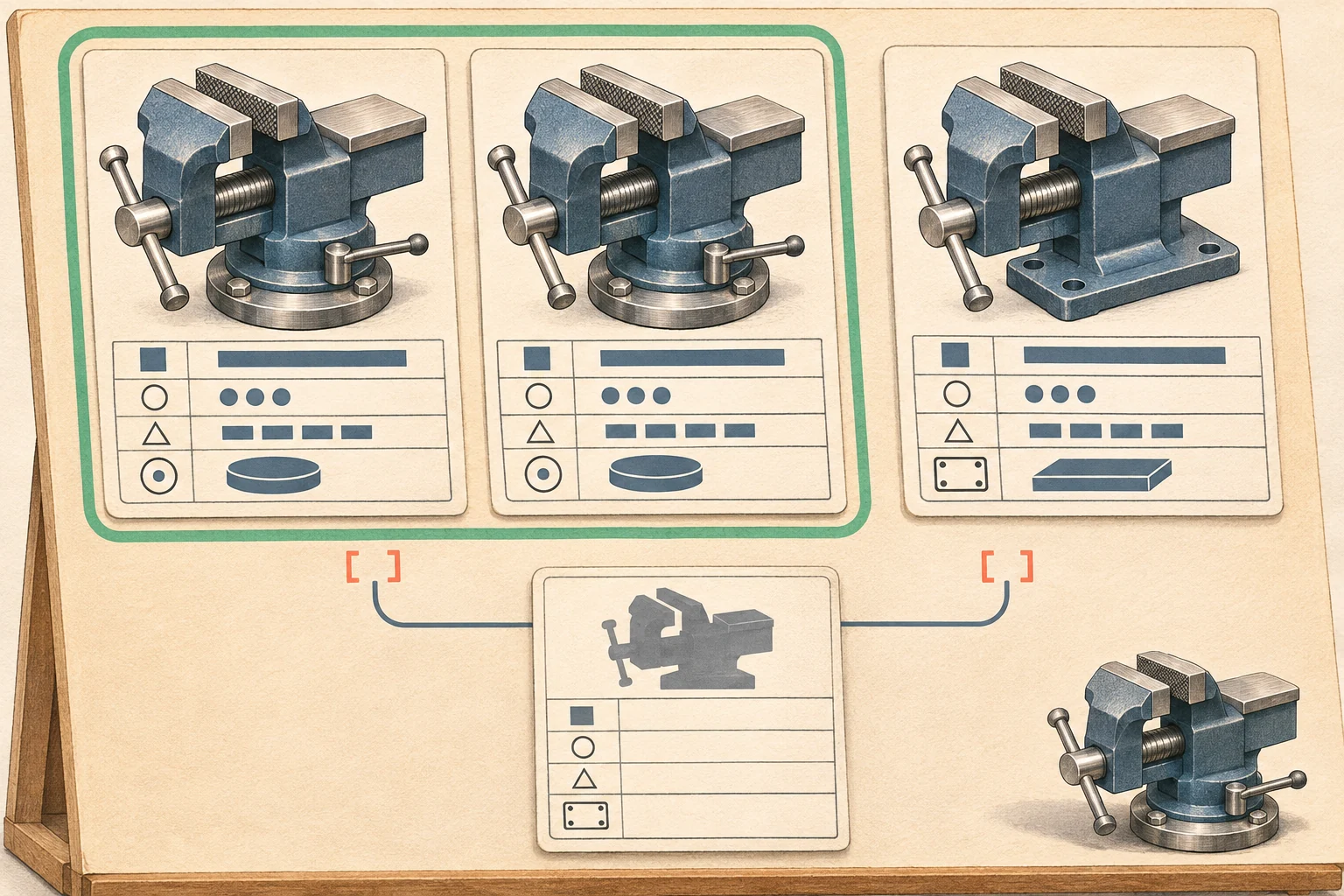
All records and numbers here are fictional; this illustrates a method rather than a model test result. The records concern one fictional manufacturer. Record A describes a V75-S vise with 75 mm jaws, a swivel base, and one unit. B describes a V75-S with 7.5 cm jaws, a swivel base, and one unit.
Record C specifies V75-F, 75 mm jaws, a fixed base, and one unit. D says only: V75 family vise, 75 mm jaws, one unit. Its full variant code and base type are missing. Similar names connect all four records but do not justify merging them.
Under the rule, A and B are confirmed duplicates: their dimensions are equivalent and the other defining attributes agree. A and C are different products. D requires clarification. Ask the model to return pair identifiers, its decision, matching attributes, contradictions, and missing information. Check each conclusion against the original records.
Review the entire group after pair decisions
A list of matching pairs is insufficient. Wang and colleagues’ entity matching research examines consistency among record relationships: independent pair decisions can ignore relationships across the group. The method proposed here therefore treats group review as a separate step.
In our example, a model might incorrectly link D to both A and C. Combining all connected records would then put swivel and fixed-base vises in one group. The direct contradiction between A and C shows that at least one intermediate decision needs reconsideration.
Before approving a group, compare the defining attributes of every member. For a small group, check every pair. An empty field should never bridge incompatible variants. Keep the uncertain record separate and state what needs clarification, rather than choosing its variant according to the majority of neighboring records.
Count incorrect matches and missed duplicates
Prepare a reference set of pairs and label it manually before viewing AI answers. Include true duplicates with different wording, similar but distinct variants, and incomplete records. Reviewers should use the original evidence and the same identity rule. Where evidence is insufficient, preserve uncertainty in the reference labels.
Illustrative calculation: of 20 pairs with known answers, 12 are true duplicates. Suppose the system confirms 10 pairs, nine correctly. Confirmation precision is then nine out of 10, or 90%, while the proportion of true duplicates found is nine out of 12, or 75%. One confirmation is incorrect; three true duplicates were missed.
Count pairs deferred for review separately: they create manual work. These measures describe the selected examples. To check candidate selection, take a small catalog segment and manually examine every pair, including those missing from the candidate list. Otherwise, misses at the initial stage remain invisible.
Prepare the merge and check a copy
Detecting a duplicate and choosing which data to retain require separate decisions. For example, Microsoft Dataverse merging involves selecting a primary record and the fields to preserve. Prepare an equally explicit register for your catalog: final identifier, original identifiers, and the source of every transferred value.
Perform the first merge check on a catalog copy. Ensure every original record either maps to a final record or remains separate with a reason. In the example, A and B become one product entry; C stays separate; D awaits clarification. Check that references from other records point to the correct entries.
The same product can have different supplier offers: prices, stock, and terms retain their respective ownership. Incomplete descriptions limit matching reliability, and successfully checking a few pairs does not establish complete deduplication. Before applying changes, retain the original copy and mapping register so every merge can be inspected or reversed.