Define what a complete list means
A neatly presented equipment list does not establish that AI found every required item. It may omit an object, include an excluded one, or repeat something already listed. Even matching expected and actual row counts cannot reveal a substitution. Verification requires a list whose individual items can be reconciled with the source document.
First define the counting unit and inclusion rule. For example, one item means one individual equipment code explicitly designated for the trip. Repeated mentions of that code remain the same item. Equipment staying at the workshop is excluded. If a code identifies an equipment type rather than an individual object, establish a different rule beforehand.
Specify the source boundaries: the document version, main text, appendices, and notes. Decide whether potentially useful equipment belongs in the output. For extraction, a practical rule is to allow only explicitly mentioned items and request suggestions separately. Completeness then refers to a defined collection of material and a clear condition.
Prepare a document map
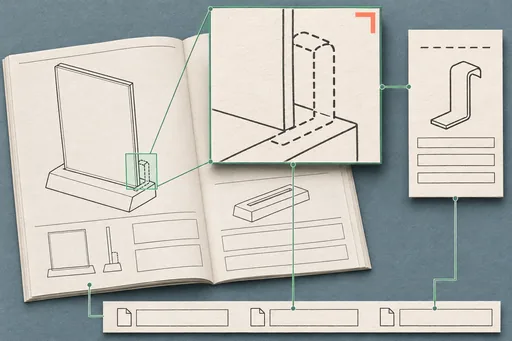
Keep an unchanged working copy and assign short identifiers to its meaningful blocks. A block might be a paragraph, list item, or note. Its identifier should make the original passage easy to locate. On a separate sheet, list every block, including those initially thought to contain no relevant equipment.
Lost in the Middle, first published in 2023, found that the position of required information affected the tested models in document question answering and value retrieval tasks. Those findings concern the study’s conditions; a current model’s behavior on your document requires a separate check.
The practical implication for our procedure is to examine coverage across the entire source. Reviewing the beginning and end leaves the middle unchecked. If processing the document in parts, retain a shared block map and record which parts were actually reviewed. The map exposes unprocessed sections, although model-generated completion marks also require checking against the text.
Example: equipment for a traveling workshop
Consider a fictional paper-making workshop. Its illustrative preparation document contains five blocks, and every object already has an individual code. The task is to list equipment being sent to the workshop.
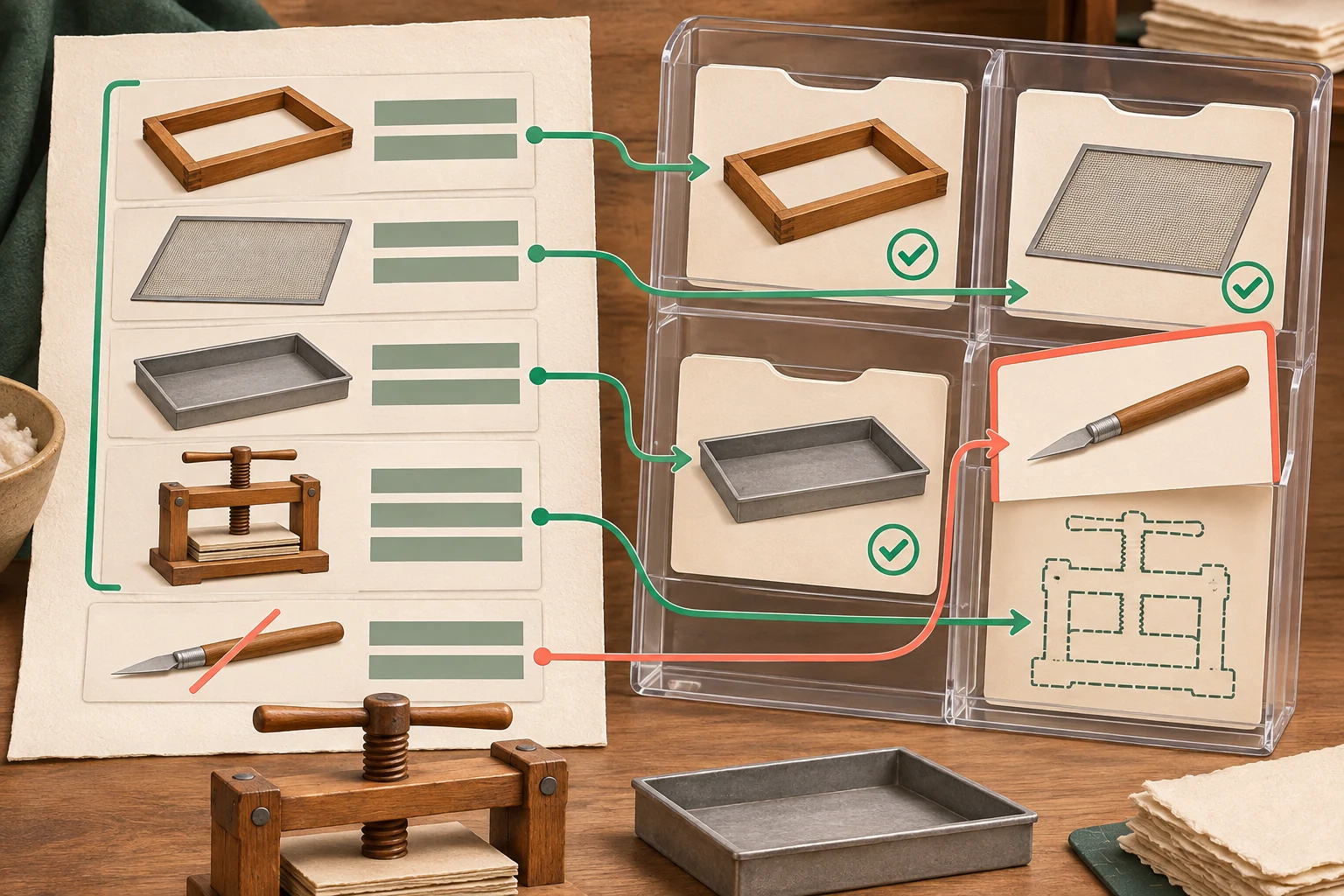
Block A1: “We are taking frame R1 and screen S1.” Block A2: “We are sending tray K1 separately.” Block A3: “Check frame R1 before loading.” Block A4: “Press P1 is being sent with the remaining equipment.” Block A5: “Knife N1 stays at the workshop.” All these statements were invented for this example.
The reference list contains R1, S1, K1, and P1. Five positive mentions produce four distinct items because the frame appears twice. Suppose an illustrative AI answer contains R1, S1, K1, and N1. Its row count matches the reference, but it omits the press and incorrectly includes the knife. This is a hypothetical answer for analysis, not a reported test result.
Request the list together with supporting evidence
Example instruction: “Extract equipment explicitly designated for shipment in the document. Each item corresponds to one individual code. Give its name, code, and supporting block identifiers. List excluded mentions and unresolved cases separately. For every source block, explain which items it adds, repeats, or excludes. Do not supplement the equipment using general knowledge.”
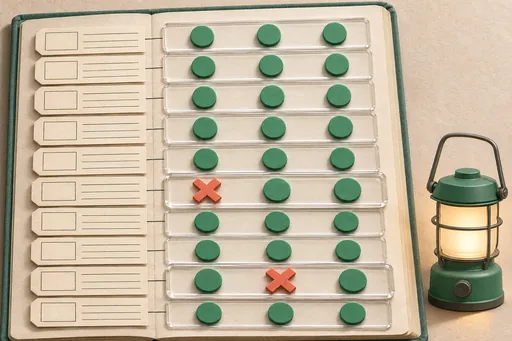
Prepare two connected outputs: the item list and the block review. The frame should reference A1 and A3, with A3 identified as a repeated mention. A5 should explain the knife’s exclusion. This record supports checking both the extracted equipment and coverage of the entire document. Keep disputed interpretations unresolved until clarified, without automatically adding an item.
Reconcile in both directions
During the first pass, work from the source toward the output. Read each block in sequence and locate its corresponding items or exclusion explanation. In the example, A4 immediately exposes the missing press. Review the block’s meaning yourself: a completion mark without a correct correspondence does not establish completeness. Record blocks whose meaning remains unresolved.
During the second pass, work from each listed item back to the source. Check that its code exists and that the passage specifically supports shipment. The knife is mentioned, but that mention requires exclusion. Then check repeated codes. Matching names without individual codes would require a separate decision about whether they identify the same object.
NIST TREC defines recall as the proportion of relevant items retrieved, and precision as the proportion of retrieved items that are relevant. Applying these definitions to distinct codes in our example gives recall of three out of four, or 75%; the proportion of correct output items is also 75%. Matching row counts concealed both errors.
Set an acceptance rule and state the limits
Check the procedure using several changes to the illustrative document. Repeat the frame mention: the list should remain unchanged. Add a new individual code designated for shipment: the list should expand. Change the press instruction to leave it at the workshop: that item should disappear. Prepare each expected set beforehand and compare codes as well as counts.
An acceptance rule can require every block to be reviewed, every eligible mention to map to an item, every item to have inclusion evidence, repetitions to be explained, and disputed cases to be resolved. After correcting an error, repeat both passes. Another answer from the same model can provide an additional clue, but cannot replace reconciliation with the source.
This method checks completeness relative to the chosen document. It does not establish whether equipment actually exists, works, or is sufficient for the workshop. An incomplete source limits the extracted list. Without an independently verified reference, the exact recall percentage is unknown. When a denominator is zero, leave that metric inapplicable and separately verify whether an empty list is justified.