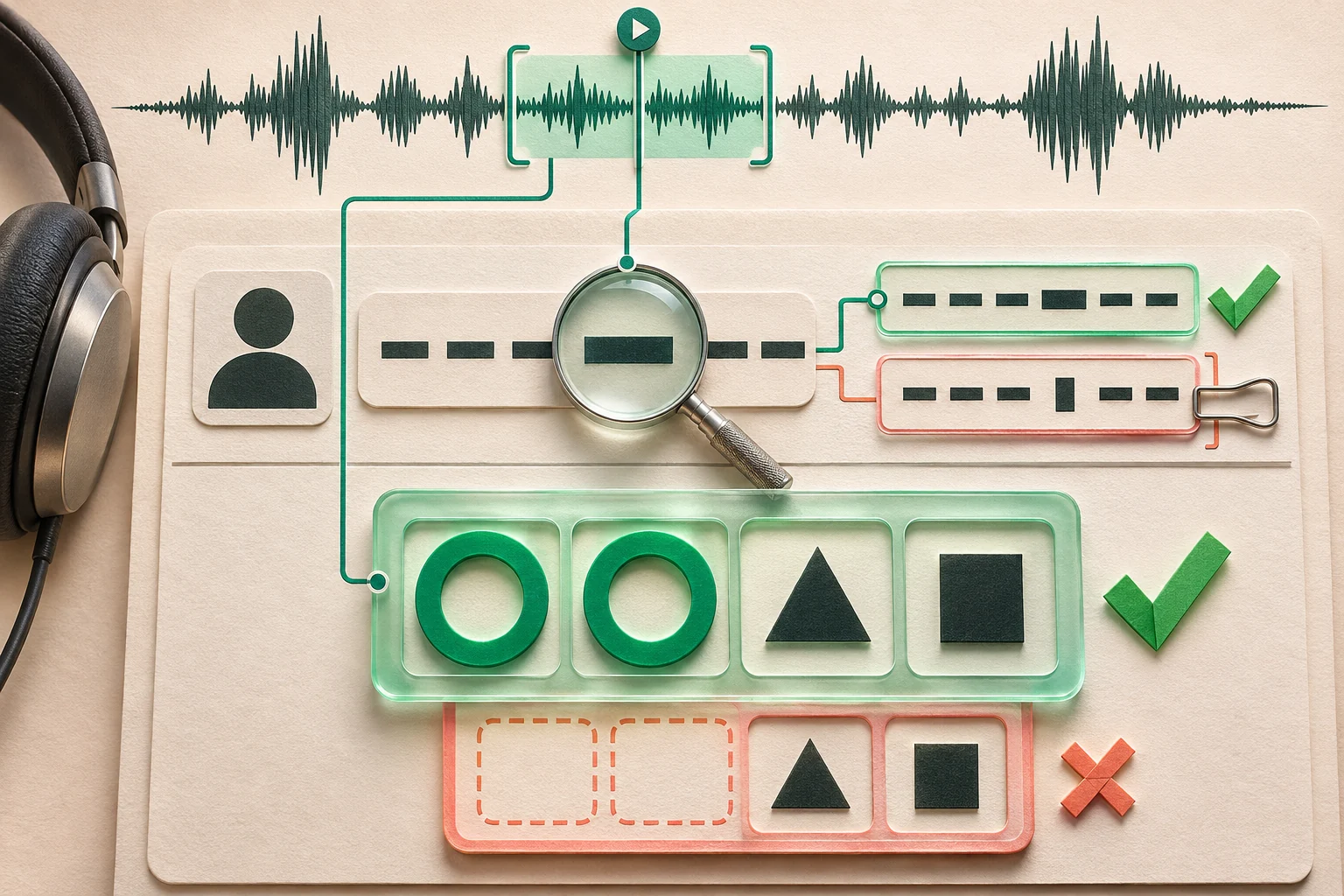
Separate spoken words from written data
A fluent transcript is not enough to assemble an order or credit an interview. A misspelled surname, a missing zero in a code, or fourteen becoming forty can change what the reader does. Check these passages separately from general editing, even when the surrounding speech looks accurate.
Microsoft describes speech recognition and display formatting as separate components: recognized words are produced first and then converted into display text. Inverse text normalization, for example, converts spoken numbers into written numerical forms. This provides a reason to check both the value heard and its representation.
Decide what each field represents before reviewing it. A quantity can be written using digits; a code requires its character sequence, including leading zeros, to remain intact. A name may need written confirmation because recognizable pronunciation does not always determine a unique spelling.
Prepare the recording and verification record
Keep the original audio and an unchanged draft. While listening, mark every name, number, code, and measurement unit, including numbers written as words. Add unclear passages and suspicious gaps. A list generated from the transcript alone cannot reveal a number that the recognizer omitted entirely.
For each passage, record its position in the audio, the draft wording, what you hear, the intended written form, the supporting evidence, and its review status. Use three statuses: confirmed, corrected, and clarification required. The last status must not silently become a definite value during editing.
Timestamps help locate a passage, but listen to the surrounding phrase too. Google warns that confidence estimates may be absent or inaccurate. Use them to prioritize listening while still checking every critical field. For a SeaGenera transcript, timestamps and confidence are available only if the provider returned them.
Example: a voice order for covers
Fictional example: a workshop receives a Russian voice order for folding screen covers. The spoken details are “code zero zero seven four,” “fourteen covers,” “length one and a half meters,” and “ready by sixteen thirty.” The recipient is Anna; her surname could be written Касаткина or Косаткина because the disputed vowel is unstressed. This ambiguity is intentional.
Suppose the draft contains “code 74, Anna Косаткина, forty covers, length 1.5 m, ready by 16:30.” There are five fields to check. The code has lost two leading zeros, and the quantity differs from the recording. The length and deadline match; the surname remains unresolved.
The accepted card records code 0074, quantity 14, length 1.5 m, and a readiness deadline of 16:30. Leave the surname unconfirmed until written clarification arrives. Keep the initial wording and the reasons for each correction in the verification record. These discrepancies illustrate the procedure; they are not results from testing a particular model.
Check the audio, then the written evidence
First listen without looking at the proposed correction and write down what you hear. Then compare it with the draft. For numbers, check the sequence or value, its unit, and its role in the sentence. “One and a half meters” can become “1.5 m,” while “zero zero seven four” must remain the identifier 0074.
Next consult an appropriate written source: a document for this particular order or a spelling supplied by the person concerned. A plausible directory match remains a candidate until linked to this request. If the related document names Anna Касаткина but the audio cannot distinguish the spellings, document that the spelling came from written evidence.
A vocabulary hint is also not evidence. Google documents adaptation for rare words, including proper names, and warns that stronger boosting can introduce a suggested word that was never spoken. When such hints are used, the surname still needs the same check. A fluent replacement proposed by a text model also remains unconfirmed.
Test the procedure with deliberate errors
Test the review procedure using a copy with deliberately inserted mistakes. In this example, replace 0074 with 74, 14 with 40, and 1.5 m with 15 m. Include an alternative surname spelling without additional evidence. Tell the reviewer this is a practice copy, but keep the locations of the changes hidden.
The procedure should catch each altered value and preserve uncertainty about the surname. Ask a second listener to check the disputed passage independently without seeing the first listener’s answer. If they disagree, retain the clarification status rather than deciding by majority. Matching answers from two recognizers also do not replace supporting evidence.
Return to the original recording and check whether the record covers every relevant passage. In the fictional example, the initial tally is two matching fields, two errors, and one unresolved field. Report those counts separately. An average word accuracy figure cannot establish that every critical field passed.
Record acceptance and its limits
Accept the text when every critical field has either been verified or explicitly held for clarification. If the next action requires a complete name, hold that action too. Do not hide the unresolved spelling inside a polished final card. After editing, compare the card against the verification record again.
Check the destination as well. When copying data into an order form, verify leading zeros, the decimal separator, the measurement unit, and the deadline wording. A correct transcript does not guarantee a correct transfer. Record which version was reviewed and who resolved disputed values.
This process checks fidelity to the recording and the documented basis for spelling. It does not establish whether the speaker’s claims were true in the real world. Noise, overlapping voices, and missing syllables may leave a value unrecoverable. In that case, request written confirmation instead of inventing the most plausible number.


