Identify which unknown prevents progress
AI can fill gaps with convincing details or stall a simple task with a lengthy questionnaire. To guide this behavior, decide in advance which unknowns actually change the outcome. The practical result is a short policy: when to continue, when to state an assumption, and when to obtain a person's answer first.
Start with the consequences of an error. An unspecified greeting usually allows a neutral draft. An unknown part of an order may change the calculation and the reply. For each gap, record which part of the work depends on it and whether the rest can be prepared separately. This establishes a reason for asking.
Microsoft's HAX Toolkit recommends clarifying intent or limiting assistance when the user's goal is unclear. Anthropic also distinguishes information that can be researched independently from preferences or intentions that the user determines. Neither principle requires asking about every possible detail.
Write rules for missing information
Create a short task record. Specify the expected result, required inputs, permitted assumptions, and stopping conditions. For a draft customer reply, for example, you might permit a neutral greeting while prohibiting invented prices and unconfirmed delivery promises. Connect each restriction to a specific part of the reply.
Example instruction for AI: “Prepare a reply using the supplied rules. If an unknown changes the scope of the service, first ask one specific question. You may write the available part of the reply immediately. Do not invent prices or deadline confirmations. Make optional stylistic decisions yourself; state consequential assumptions separately.”
Check whether the policy is understandable without involving a model. Another person should be able to explain how to handle each gap. If the record only says “clarify when necessary,” the decision is effectively left to AI. Add an example of a necessary question and an example of a situation where asking would be unnecessary.
Example: a photo album digitization request
Consider a fictional example. A customer writes: “How much does digitizing two albums cost? I need JPG files by November 15, with no prints.” Under the workshop's illustrative rules, it can scan whole pages or individual photographs. Pricing follows an assessment of the volume, and an employee confirms the deadline based on workload.
The number of albums does not yet establish the number of scans. The first useful question is: “Do you need whole album pages scanned, or each photograph separately?” The available part of the reply can acknowledge the request for JPG files without prints. There is currently no basis for a final price or a guaranteed completion date.
Suppose the customer replies: “Whole pages, 80 pages in total.” The next draft should use both new facts and explain the remaining requirements for a calculation. If the supplied material contains no rate, the number 80 alone cannot produce a price. There is no need to ask again about scanning mode, file format, or prints.
Ask a question that changes the next step
Google's conversation design guidance recommends asking one question at a time and narrowing its focus when resolving ambiguity. In our example, that means naming two understandable scanning options, then allowing the customer to choose or describe a different request.
Compare these example questions: “Please clarify all order requirements” and “Do you want to preserve each whole page, including the arrangement of photographs, or receive a separate file for each photograph?” The second explains the difference through the result the customer receives. Answering requires no knowledge of the workshop's technical terminology.
Before including a question in a draft, check what answer is expected and what will change afterward. If every answer leaves the next step unchanged, remove or postpone the question. If the customer has not decided, offer a brief comparison; the unknown preference should remain unresolved until they choose.
Check the conversation with six scenarios
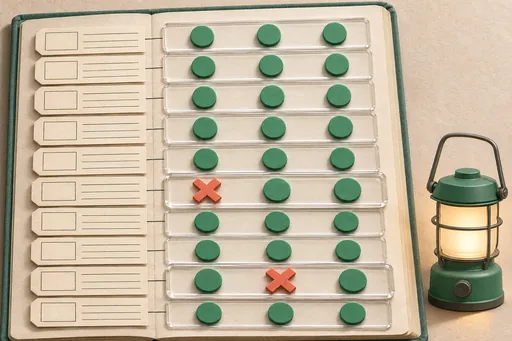
Prepare six illustrative scenarios and record the expected behavior in advance. First: all necessary information and confirmations are present, so AI drafts the reply without clarification. Second: only the greeting preference is missing, so AI chooses a neutral greeting. These cases reveal questions that delay work that is ready to proceed.
Third: the scanning mode is missing, so a question about the service outcome is required. Fourth: after that question, the customer says “whole pages, 80 pages,” so AI uses the answer without asking the same thing again. Review the entire exchange: a good opening question does not establish that the continuation is correct.
Fifth: the customer does not know the volume, so AI may explain what must be counted while leaving the price unresolved. Sixth: the customer answers “as usual,” with no available order history, so the meaning needs clarification. Track missed necessary clarifications, unnecessary questions, and invented promises separately. This is a verification plan, not a report of completed runs.
Define the limits of use
For manual work in SeaGenera, you can provide a text model in Playground with the customer's message, workshop rules, and reply requirements. Keep these materials together with the expected behavior outside the conversation so the next review uses the same foundation. The wording of a question may change while its purpose stays consistent.
An instruction to clarify does not guarantee that a model will detect every consequential gap. A person therefore checks the fields that determine commitments: service scope, price, and confirmed deadline. A clarifying question also does not verify whether a price list or workshop workload is current. That information must come from an appropriate source.
Repeat the six scenarios after changing the service rules, prompt, or model. Compare decisions about continuing the work, rather than only the politeness of the wording. The final record should identify required information, permitted assumptions, and the question that resolves a specific uncertainty. It can then guide replies to subsequent messages.