What to ask the model to do
Z.ai’s official Hugging Face model card describes GLM-5.3-Flash as a native multimodal model. Here we examine a text scenario: allocating limited stock across several orders. The practical result is a plan connecting each requirement to a specific item, rather than a general assurance that there should be enough equipment.
This is a useful trial scenario for packaging rentals, equipment checkout, and kit assembly with permitted substitutions. You can ask the model to propose an allocation and explain obstacles. All examples below are fictional, and reference solutions are worked out manually. This is a methodological review, not a testing report: no paid model requests were made.
Describe stock and substitution rules
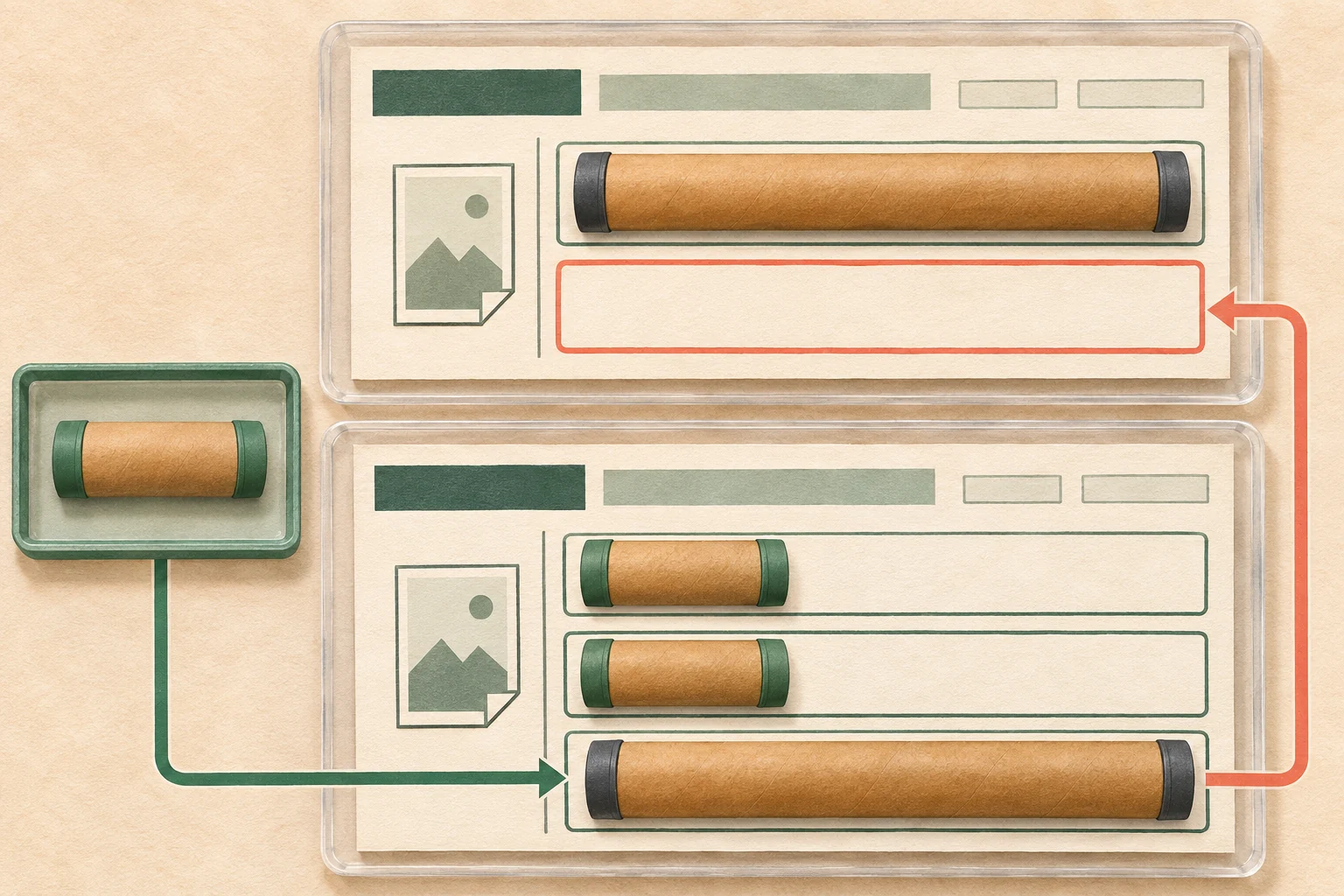
Fictional example: a rental desk supplies protective tubes for posters. Available stock consists of three short tubes, S1, S2, S3, and two long tubes, L1, L2. In this illustrative task, a long poster fits only a long tube, while a short poster may use either type.
Order A needs tubes for two long posters; order B needs tubes for three short posters. Both orders leave simultaneously. Each tube holds one poster and may serve only one order. Buying packaging, packing several posters together, or relying on a return between dispatches is prohibited.
Give the model available stock, excluding committed items. State compatibility rules explicitly. Define the objective separately: fulfill both orders without breaking any conditions. If partial fulfillment is acceptable, you need a different selection rule; the model should not independently decide which customer takes priority.
Two example prompts
First example prompt: “Propose a tube allocation. Stock: short tubes S1, S2, S3; long tubes L1, L2. Order A: two long posters. Order B: three short posters. Long posters require long tubes; short posters accept either type. One tube holds one poster, reuse is prohibited, and dispatch is simultaneous. Fulfill both orders completely without purchasing anything. List assigned tubes for each order, then remaining stock and unmet requirements. Do not change the conditions.”
Manual reference solution: assign L1 and L2 to order A, and S1, S2, S3 to order B. Nothing remains unused or unfulfilled. This valid allocation provides a reference for reviewing the answer’s structure. Swapping S1 and S2 within an order changes nothing, so do not demand an exact textual match.
Second example prompt, continuing the conversation: “Keep the conditions, but replace long tube L2 with short tube S4. Available stock is now S1, S2, S3, S4 and L1. Check whether both orders can be fulfilled completely. If not, identify requirements lacking compatible tubes and compare required and available quantities. Do not treat failure to find a plan as proof of impossibility.”
Verify the allocation independently
First compare assignments with the original stock: every identifier must exist and appear at most once. Then check each assignment’s compatibility and the number of fulfilled requirements. For each type, allocated quantity plus remaining quantity must equal starting stock. A polished explanation cannot compensate for an invented or reused item.
In the second example, there are still five tubes and five posters. However, two long posters require two long tubes, while only L1 is available. Two requirements competing for one compatible unit explain why complete fulfillment is impossible. Unused short tubes cannot resolve this shortage. You can verify the explanation without trusting the model’s reasoning.
Test the acceptance procedure using two deliberately flawed illustrative plans: assign L1 to both orders in one, and assign short tube S1 to a long poster in the other. Reject both. Record the rejection reason beside the assignment. A valid plan establishes feasibility, but does not by itself establish uniqueness or optimality.
Available SeaGenera settings
The supplied catalog lists the model in SeaGenera’s Playground and API, with text output. It does not generate finished images, videos, or speech. Text mode is sufficient here. SeaGenera’s documentation snapshot dated November 11, 2026 confirms max_tokens, which limits total output, including reasoning tokens.
The developer’s official model card lists reasoning_effort levels low, high and max, with max as the default. SeaGenera’s catalog marks reasoning as mandatory, so disabling it is unavailable here. You could explicitly choose high as a starting setting for a trial while keeping verification conditions fixed. A higher level does not replace assignment checks. Do not combine reasoning_effort with the reasoning object.
Z.ai’s README also describes clear_thinking as a chat template parameter. The supplied SeaGenera documentation does not list this field, so do not transfer it into a request. Tool support does not automatically issue inventory either: the client application executes functions. This scenario requests only an allocation proposal, without changing inventory records.
Cost and practical limits
SeaGenera’s catalog lists separate input, output, and cache reading rates in rubles per token. For an ordinary text attempt, estimate input volume at its input rate plus output volume at its output rate; account for caching separately if confirmed. Check current rates in the model card and on /pricing, rather than importing external dollar prices.
Check the displayed reserve before submitting. SeaGenera’s documentation says confirmed cost is charged and unused reserve returned. Generating an answer for the modified example would be a separately paid attempt if you choose to run it. A short final plan does not reveal the full processing volume.
A large inventory with many substitutions, deadlines, and priorities requires specialized calculation and independent verification. The model might overlook a valid allocation or claim a shortage without sufficient support. If it finds no plan, keep the result unconfirmed until a verifiable explanation is available. Use this scenario as a small pilot for dispatcher assistance.


